
Google DeepMind unveiled Gemini 4 Carbon recently, a frontier AI model engineered for autonomous software security and vulnerability patching.
The release comes two weeks after the debut of Gemini 4 Argon and moves Google to the top of the Artificial Analysis Intelligence Index v5.0 with an aggregate score of 59, edging out Anthropic’s Claude Opus 5.5.
Gemini 4 Carbon can autonomously detect and fix security vulnerabilities
Unlike general-purpose conversational models, Carbon is optimised to run multi-day reasoning loops focused on identifying code vulnerabilities, validating their exploitability and drafting remediations.
While Gemini 4 Argon targeted general reasoning and developer workflows, Carbon is tailored to defensive security and autonomous software remediation.
Google confirmed Carbon will launch on its Gemini API at an introductory rate of USD2.00 (~RM8.13) per million input tokens and USD10.00 (~RM40.64) per million output tokens, before shifting to standard rates of USD4.00 (~RM16.26) and USD20.00 (~RM81.28).
Cached input tokens carry a 95 percent discount, reducing the introductory caching cost to USD 0.10 (~RM 0.41) per million tokens, and USD 0.20 (~RM 0.81) once standard pricing takes effect. The discount targets enterprise developers running repetitive, multi-repository codebases through automated security sweeps.
The introductory pricing structure matches Argon, positioning Carbon to compete directly on operational costs against frontier models from Anthropic and OpenAI.
How Gemini 4 Carbon compares with other AI models
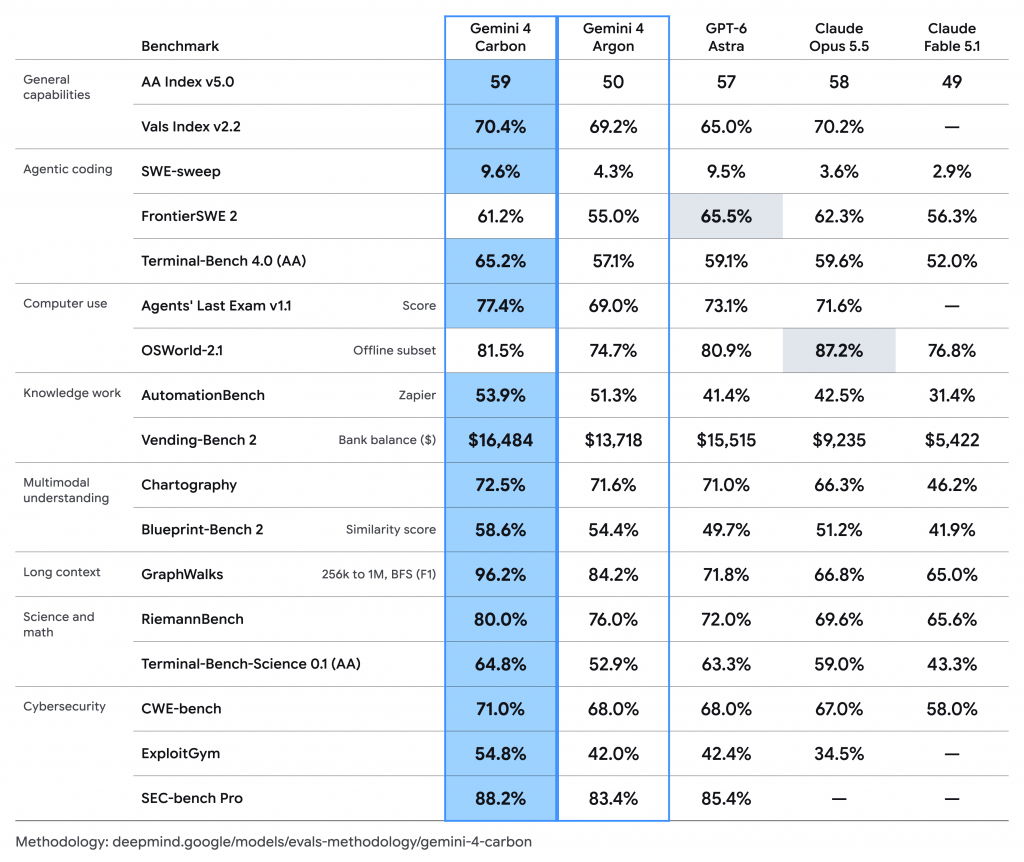
On third-party evaluations, Carbon is ranked first on the Artificial Analysis Intelligence Index v5.0 with an aggregate score of 59, narrowly passing Claude Opus 5.5 at 58 and OpenAI’s GPT-6 Astra.
Google reported the model led 15 of 17 standard benchmark evaluations, trailing competitors only in software engineering on FrontierSWE 2 and computer use on OSWorld-2.1.
The architecture focuses heavily on the vulnerability remediation lifecycle across three distinct stages: discovery, validation and remediation. Carbon recorded an 88.2% score on SEC-bench Pro for detecting security flaws across codebases, followed by 54.8% on ExploitGym for evaluating exploitability and 71.0% on CWE-bench for automated patch generation.
Google DeepMind claimed Carbon produced viable security fixes at more than twice the rate of Argon. Google also claimed that Carbon achieved more than twice the success rate of Argon in generating secure code. Meanwhile, its Chrome team reported that Carbon performed over 10 times better than a competing frontier model at generating high-quality software patches.
How reliable is Gemini 4 Carbon against cyber attacks?
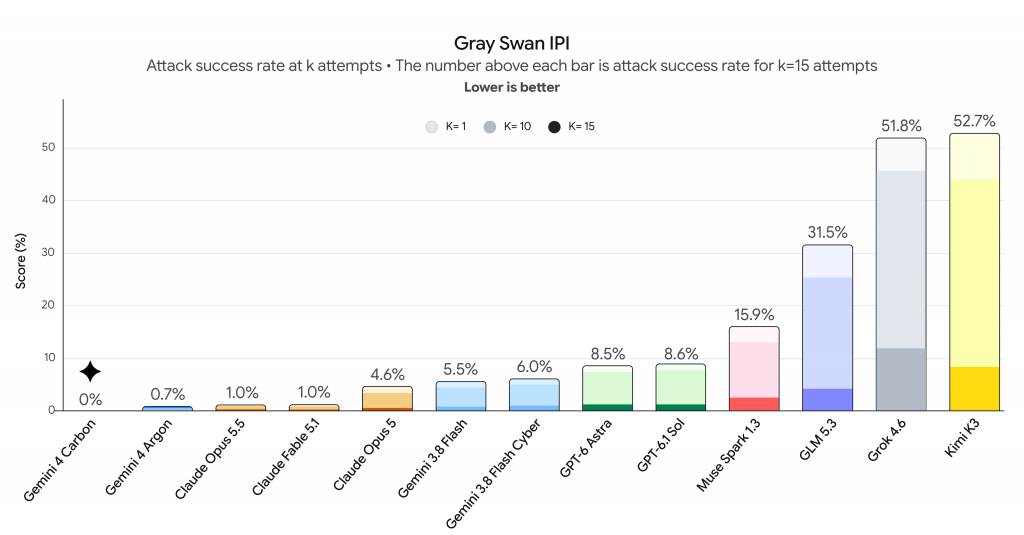
Google DeepMind reported zero successful attacks against Carbon on Gray Swan’s Indirect Prompt Injection benchmark, down from a 0.7 percent breach rate recorded by Argon.
The company also measured a 26 percent reduction in operational overreach actions taken outside user-defined parameters and a 29 percent decline in under-service, where agents abandon multi-step tasks before completion.
On Terminal-Bench 4.0, Carbon reduced successful environment exploits and rule-breaking shortcuts to 0.0 percent, with total attempts dropping to 0.4 percent. In internal testing, DeepMind stated the model halved unsupported claims relative to Argon.
Third-party testing by Artificial Analysis placed Carbon first on its AA-Omniscience evaluation with a score of 54. The firm recorded an 11 percent hallucination rate for Carbon, rising from Argon’s 4 percent but well below the 50 percent rates registered by both Claude Opus 5.5 and GPT-6 Astra.
No specified timeline or launch date for the public
Google is restricting initial access to Carbon to a subset of cybersecurity defenders beginning this week. The company will gradually expand access to additional trusted partners through its Fairwind Program, an initiative that provides early model access to select government bodies, critical infrastructure operators and enterprise defense teams.
Google also confirmed it is participating in the U.S. government’s voluntary process for pre-release model testing. The company plans to gather defender feedback and refine safety controls before rolling out Carbon to developers, enterprise clients and consumers across Vertex AI, the Gemini API and the Gemini consumer application. A general availability date has not been announced.
[ SOURCE ]