Southeast Asia’s smartphone market has taken a significant hit in Q3 2026, as memory supply shortages and rising component costs continue to affect smartphone manufacturers.
According to the latest research by market analyst firm Omdia, smartphone shipments across Southeast Asia plunged 36% year-on-year from 25.6 million to 16.5 million units. Malaysia was among the markets hardest hit, recording a shipment decline of more than 30%.
Interestingly, while smartphone shipments declined sharply, Omdia reported that the overall market value fell by just 1%. This comes as average selling prices (ASP) increased by a whopping 53% year-on-year.
Omdia’s latest figures also show Xiaomi emerging as Malaysia’s No. 1 smartphone brand, while Honor climbed to second place, ahead of Samsung.
Xiaomi leads Malaysia with 21% market share, Honor rises to No. 2
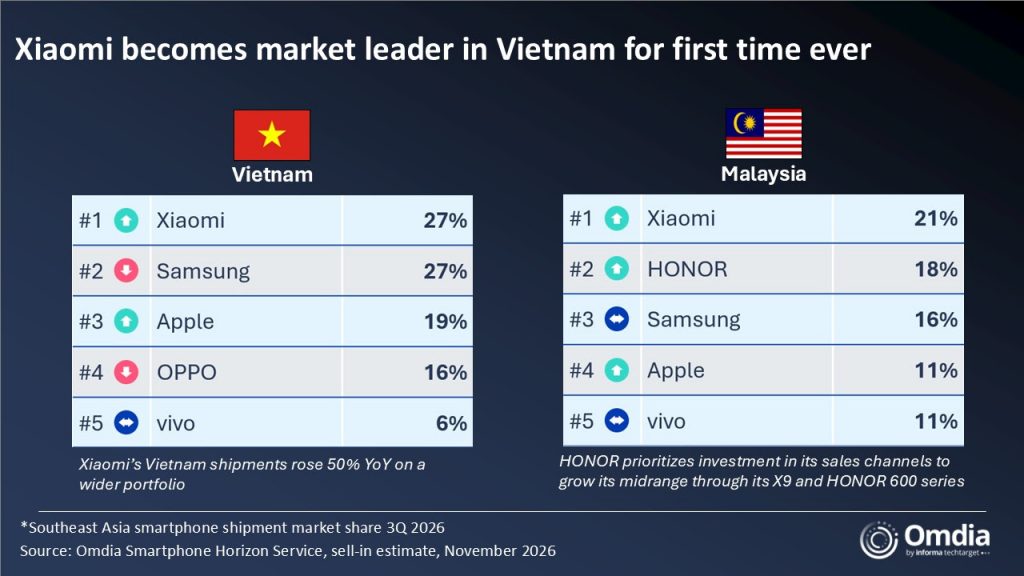
According to Omdia’s latest report for Q3 2026, Xiaomi is now the #1 smartphone brand in Malaysia with a 21% market share based on smartphone shipments.
Honor climbed to second place with an 18% share, while Samsung took third with 16%. Apple came in fourth with 11%, followed by Vivo, also with 11%.
This marks the first time Honor has secured second place in Malaysia’s smartphone market, according to Omdia. The research firm highlighted Honor’s investments in its sales channels to grow its mid-range smartphone business, particularly through its Honor X9 and Honor 600 series.
Omdia Research Manager Le Xuan Chiew said Honor’s focus on premium mid-range smartphones, rather than the budget phones below USD 200 (below RM900), has helped reduce its exposure to memory supply constraints.
The research firm also highlighted Honor’s expanded presence in telco operator channels, which account for a significant proportion of smartphone purchases.
Samsung remains Southeast Asia’s No. 1, Apple the only top-five brand to grow
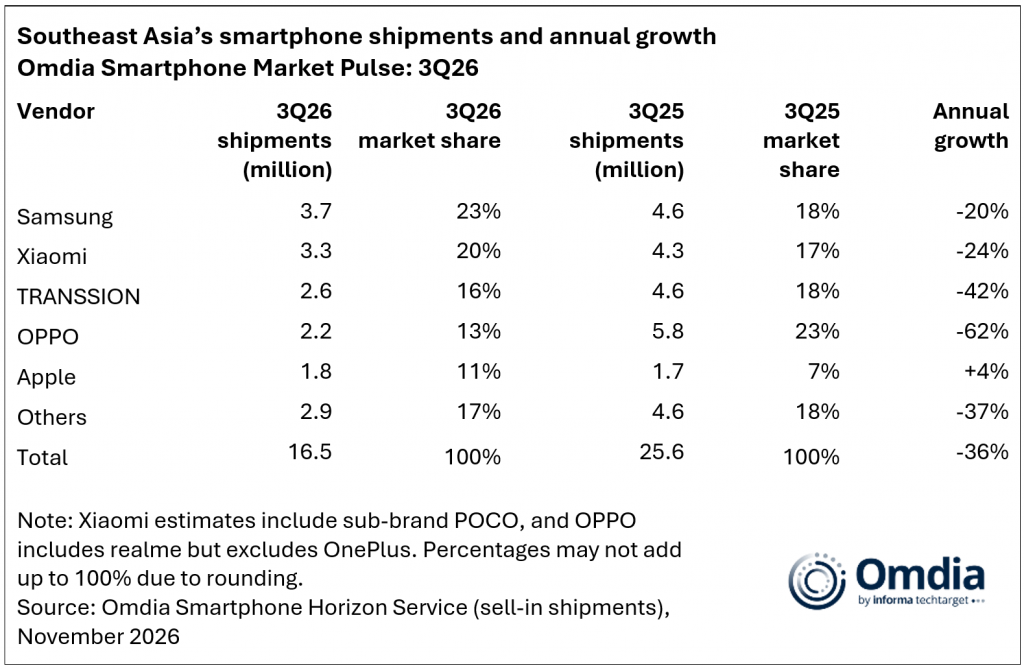
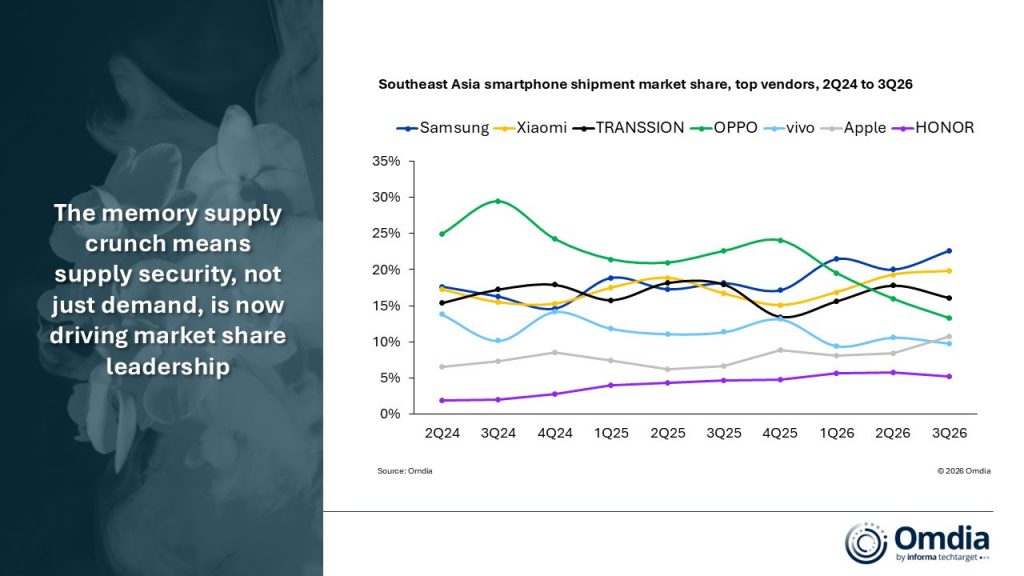
At the regional level, Samsung maintained its position as Southeast Asia’s largest smartphone vendor despite recording a 20% year-on-year decline in shipments to 3.7 million units. Samsung’s market share is at 23% in Q3 2026, up from 18% in Q3 2025.
Xiaomi came in second with 3.3 million units shipped, representing a 20% market share, followed by TRANSSION, the company behind Infinix, Tecno and itel, with 2.6 million units and a 16% share.
Oppo, which Omdia groups together with Realme, suffered the steepest decline among the top five vendors. Its shipments plunged 62% to 2.2 million units, bringing its market share down from 23% to just 13%.
Meanwhile, Apple was the only top-five smartphone vendor to record positive shipment growth, increasing 4% year-on-year from 1.7 million to 1.8 million units. This helped Apple grow its regional market share from 7% to 11%.
While Samsung and Xiaomi recorded double-digit shipment declines, both brands managed to increase their regional market share. In contrast, Oppo’s market share dropped by 10 percentage points compared to the same period last year.
Omdia attributed Oppo’s decline to its strategic withdrawal from the ultra-budget smartphone segment priced below USD 100 (below RM500), where rising memory costs have made it increasingly difficult to maintain profitability.
Omdia attributed Apple’s growth to stronger performance in Malaysia and Vietnam. The research firm also noted that Apple’s premium-focused portfolio made it less vulnerable to memory supply constraints affecting smartphones priced below USD 200.
It also added that growing availability of Buy Now Pay Later (BNPL) schemes, including SPayLater, has helped improve the affordability of premium smartphones.
Smartphone shipments continue to decline, Vietnam the only exception
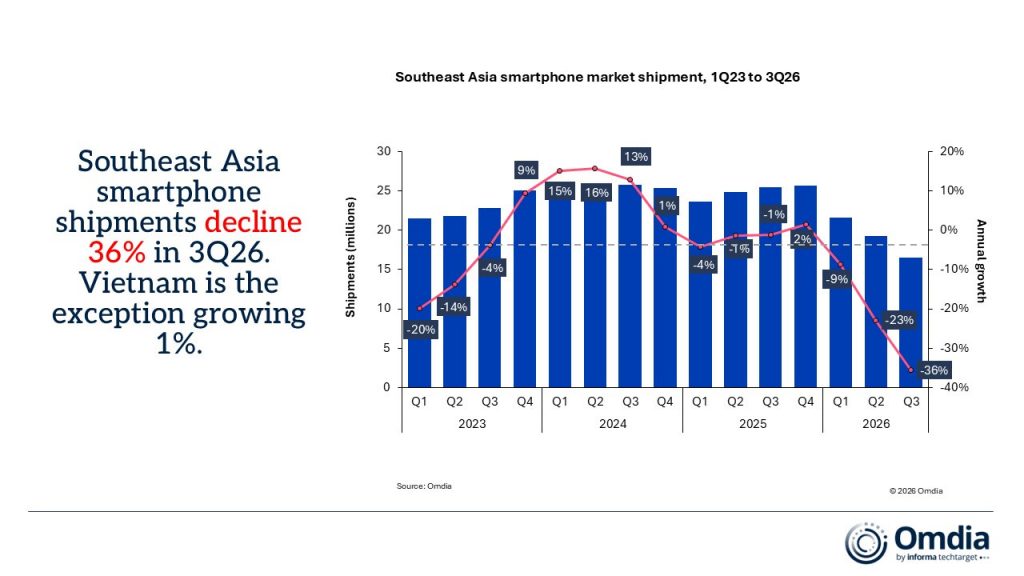
Omdia’s figures also show that Southeast Asia’s smartphone market has been declining for several consecutive quarters.
After recording 2% year-on-year growth in the fourth quarter of 2025, regional smartphone shipments fell 9% in Q1 2026, followed by a 23% decline in Q2 2026. The downturn accelerated further to 36% in Q3 2026.
It found that Vietnam was the only Southeast Asian market to record positive growth during the quarter, with shipments increasing 1% year-on-year.
Xiaomi also emerged as Vietnam’s leading smartphone vendor for the first time, with shipments increasing 50% year-on-year. It secured a 27% market share, marginally ahead of Samsung, which also recorded a rounded market share of 27%.
Meanwhile, all other Southeast Asian markets recorded double-digit shipment declines. Malaysia, Indonesia, the Philippines and Thailand each experienced declines exceeding 30%.
Omdia attributed Vietnam’s relatively resilient performance to its stronger economic growth, supported by foreign direct investment, manufacturing activity and exports linked to global demand for AI hardware.
Memory shortages are forcing smartphone brands to rethink pricing and specifications
Although Southeast Asia’s smartphone shipments have fallen significantly, Omdia cautioned that the decline should not automatically be interpreted as weaker consumer demand.
Omdia Senior Analyst Sheng Win Chow said, “Vendors can still supply devices across almost every price segment above $100, but they can no longer offer the same memory and storage specifications at previous price points. The impact on consumer demand will depend on how buyers respond to these changes and whether they consider the trade-offs acceptable. As a result, vendors are focusing their marketing on the practical benefits of new devices rather than headline RAM and storage specifications.”
He explained that the actual impact on consumer demand will depend on whether buyers are willing to accept these compromises.
According to Omdia, smartphone manufacturers are increasingly highlighting practical features and benefits rather than focusing on headline RAM and storage specifications.
The research firm noted that the impact is particularly significant for manufacturers competing in the ultra-budget segment, where profit margins are already thin.
For example, Omdia estimates that Vivo’s year-to-date smartphone shipments declined 33% in 2026, while its ASP increased 37%. The company had already been working to reduce its reliance on smartphones priced below USD 100, and Omdia believes memory supply pressures have accelerated this shift.
Based on Omdia’s findings, smartphone manufacturers are increasingly prioritising higher-priced devices as component costs rise. While premium brands such as Apple have been relatively resilient, manufacturers relying heavily on budget smartphones are facing greater pressure.
For consumers, the key question is whether smartphone brands can continue delivering meaningful upgrades at affordable prices. With memory and storage costs increasing, buyers will have to choose between paying significantly more for their next smartphone which they can hold on to for years to come, or accepting a budget phone with less RAM and specs compared to their respective predecessor.