• 中文版
  • BM
  • News
  • Deals
  • Reviews
    • First Impressions
    • Hands-on
    • Comparisons
  • Tech
    • Mobile
    • Computers
    • Cameras
    • Wearables
    • Audio
    • Drones
  • Telco
    • Celcom
    • Digi
    • Maxis
    • Time
    • Tune Talk
    • U Mobile
    • Unifi
    • Yes
  • Cars
  • Contribute
  • Jobs
Menu
  • 中文版
  • BM
  • News
  • Deals
  • Reviews
    • First Impressions
    • Hands-on
    • Comparisons
  • Tech
    • Mobile
    • Computers
    • Cameras
    • Wearables
    • Audio
    • Drones
  • Telco
    • Celcom
    • Digi
    • Maxis
    • Time
    • Tune Talk
    • U Mobile
    • Unifi
    • Yes
  • Cars
  • Contribute
  • Jobs
Search
  • Tech
    • News
    • Mobile
    • Computers
    • Cameras
    • Wearables
    • Audio
    • Drones
  • Telco
    • Celcom
    • Digi
    • Maxis
    • Time
    • U Mobile
    • Unifi
    • Yes
  • Reviews
    • First Impressions
    • Hands-on
    • Comparisons
  • Buyer’s Guide
  • Opinions
  • Digital Life
  • Video
  • Deals
  • How-To
  • Cars
  • Bahasa Melayu
  • EV
  • Contribute
  • Advertise
Menu
  • Tech
    • News
    • Mobile
    • Computers
    • Cameras
    • Wearables
    • Audio
    • Drones
  • Telco
    • Celcom
    • Digi
    • Maxis
    • Time
    • U Mobile
    • Unifi
    • Yes
  • Reviews
    • First Impressions
    • Hands-on
    • Comparisons
  • Buyer’s Guide
  • Opinions
  • Digital Life
  • Video
  • Deals
  • How-To
  • Cars
  • Bahasa Melayu
  • EV
  • Contribute
  • Advertise
Search
Close
Home News

COVID-19: When are you considered a close contact? Malaysia’s MOH explains

  • BY soyacincau
  • 10 October 2020
  • 9:43 pm
  • Comment
Share on FacebookShare on Twitter

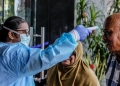
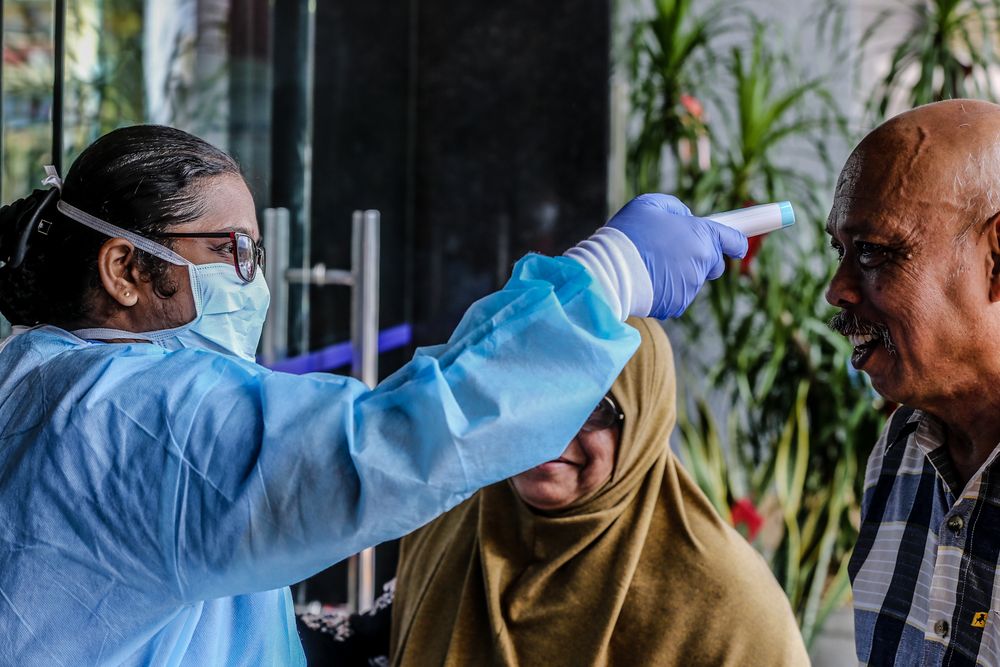
As the country faces a third wave of COVID-19 infections with hundreds of new cases daily, health workers, besides treating them, have the arduous task of locating infected patients’ close contacts to avoid new clusters emerging and contain the spread.

A close contact, if infected, could unknowingly be spreading the virus around while remaining asymptomatic, further expanding the chain of infection or cluster.

But how would we know if we are a close contact? And what are close contacts?
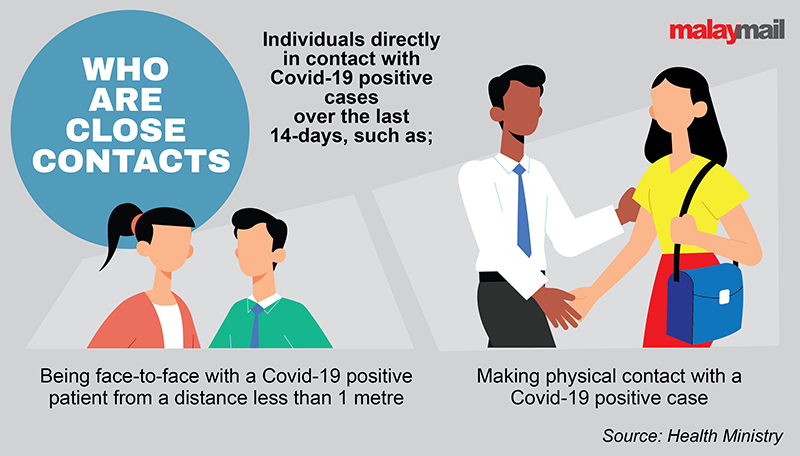
According to the Ministry of Health, close contacts are individuals who have been in direct contact or have interacted with a person who was later confirmed as a COVID-19 patient.

Due to the nature of the coronavirus with an incubation period of up to 14 days, contact tracing exercises are aimed at detecting every single person the infected individual met or interacted with over the last two weeks.

Who are close contacts?
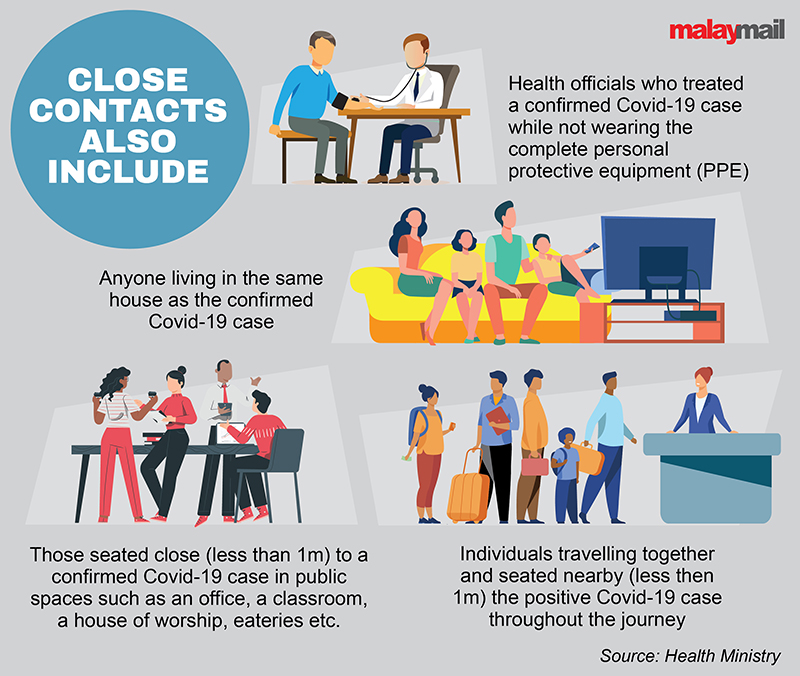
Anyone who was face-to-face and less than a metre away or had physical contact with a confirmed COVID-19 case up to 14 days before they tested positive, would automatically be deemed a close contact.

This includes anyone living in the same household as the infected individual, and those seated less than one metre away from the positive case in places such as an office, a classroom, in eateries or any other public spaces for a prolonged period of time.

Travellers who were on the same trip, specifically those seated less than a metre away from the infected person throughout their journey will also be listed as a close contact.

Health officials not fully equipped with the complete personal protective equipment (PPE) who treated patients later confirmed as a Covid-19 case are also deemed as close contacts.

The two types of close contacts
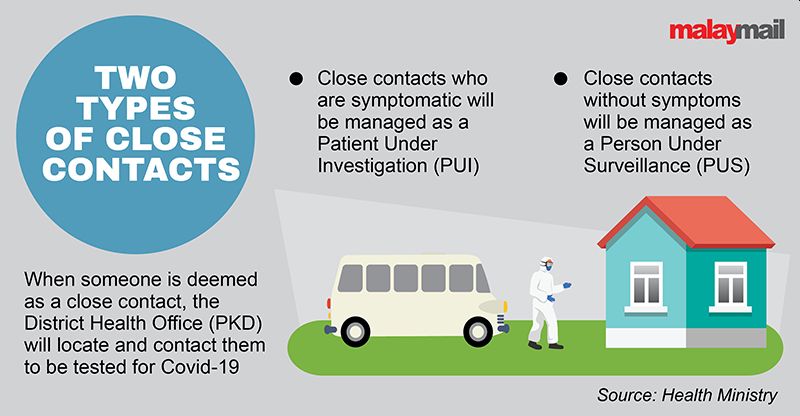
After someone has been established as a close contact, the closest District Health Office (PKD) will detect and locate them through contact tracing measures and screen them for COVID-19.

From there, these close contacts are separated into two categories.

Those exhibiting symptoms would be classified as a Person Under Investigation (PUI), while an asymptomatic close contact is listed as a Person Under Surveillance (PUS).

Close contacts who later test positive for COVID-19 would immediately be brought to a public hospital to be isolated and treated.

Those who test negative on the first screening are required to serve a 14-day home quarantine, will be tested again on the 13th day and released from their quarantine once they get a negative result. ― Malay Mail

[ IMAGE SOURCE ]

Tags: contact tracingcovid-19Ministry of Health
soyacincau

soyacincau

POPULAR

COVID-19: When are you considered a close contact? Malaysia’s MOH explains

October 10, 2020
Proton Saga Cross AMA02 by Theottle

Proton Saga Cross AMA02 to begin production in October?

May 4, 2026
BYD Tech Discovery KL

MITI’s CBU EV ruling will wipe out current EV lineup from BYD, iCaur, Mini, Smart, Toyota, and more

May 7, 2026

TNG eWallet to disable auto-reload for debit cards from 13 May 2026

April 30, 2026

YouTube Premium Lite now in Malaysia: Ad-free viewing from RM12.90/month

May 4, 2026

MITI increases minimum CBU EV price to RM300K? Imported EVs with 240hp and below not allowed?

May 6, 2026

Copyright © 2025 · SoyaCincau.com
Mind Blow Sdn Bhd (1076827-P)

  • ADVERTISE
  • DISCLAIMER

Copyright © 2026 · SoyaCincau.com – Mind Blow Sdn Bhd (1076827-P)

  • ADVERTISE
  • DISCLAIMER