

5G isn’t just about faster mobile data. With a proper 5G Standalone (5G SA) network, your voice calls can also run entirely over 5G via Voice over New Radio (VoNR).
Besides offering higher voice quality, VoNR offers users a more responsive phone call experience, with instantaneous call setup times compared to existing Voice over LTE (VoLTE) on 4G. However, having the latest technology doesn’t automatically mean a better experience.
According to Ookla’s recent report which studies mobile voice call setup times across several markets, implementation matters more and VoNR may not necessarily better than VoLTE. In Malaysia, Yes 5G’s VoNR implementation delivers a strong showing, while U Mobile’s 5G voice experience takes longer to set up a call.
The report also highlights examples in markets such as South Korea and Singapore where newer 5G voice implementations don’t necessarily provide improvements over existing VoLTE services.
What is VoNR and why does call setup time matter?
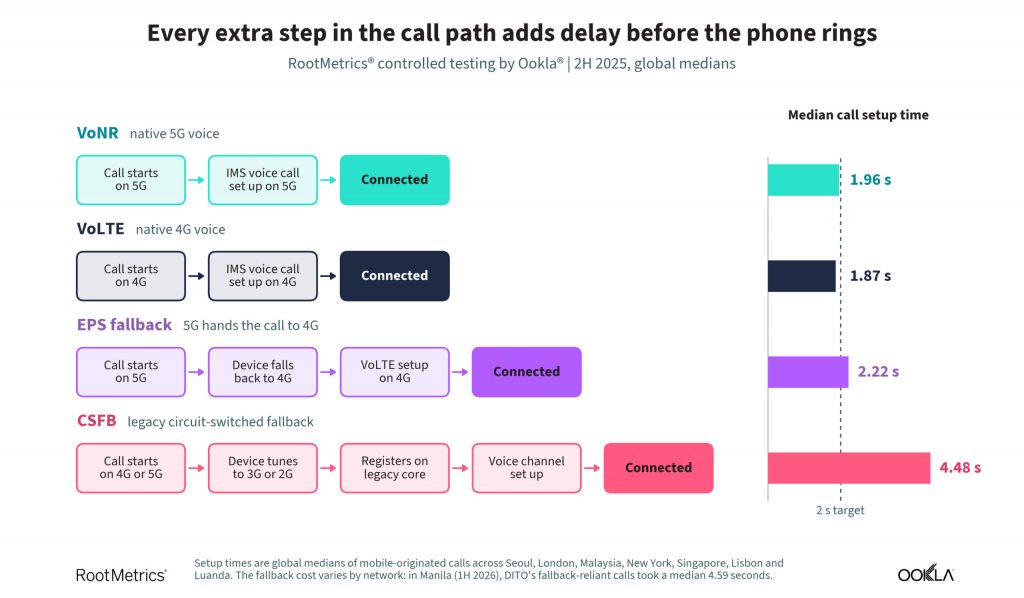
Voice over New Radio or VoNR is essentially the 5G version of VoLTE. When connected to a 5G Standalone network equipped with a 5G core, your smartphone will remain connected to 5G while making or receiving a phone call. This means if you’re using your phone for data intensive task or as a hotspot, your data connection shouldn’t degrade when you receive an incoming call.
As a comparison with a 5G Non-standalone (5G NSA) setup, your connection would have to drop from 5G to 4G whenever a voice call is made.
Malaysia has supported VoLTE for years and a properly implemented VoLTE service already offers a quicker call setup time. With VoNR, customers expect a superior experience when they are connected to 5G.
One of the easiest ways to notice the difference is call setup time. This refers to the time it takes from tapping the call button and hearing the first ringback tone.
Ookla regards a call setup time of around two seconds as the gold standard for a responsive voice experience. The shorter the delay, the more immediate a phone call feels.
If a connection falls back onto legacy technologies including Evolved Packet System (EPS) or Circuit Switch Fallback (CSFB), it could take over 4 seconds just to connect a call.
Yes 5G VoNR versus U Mobile 5G in Malaysia
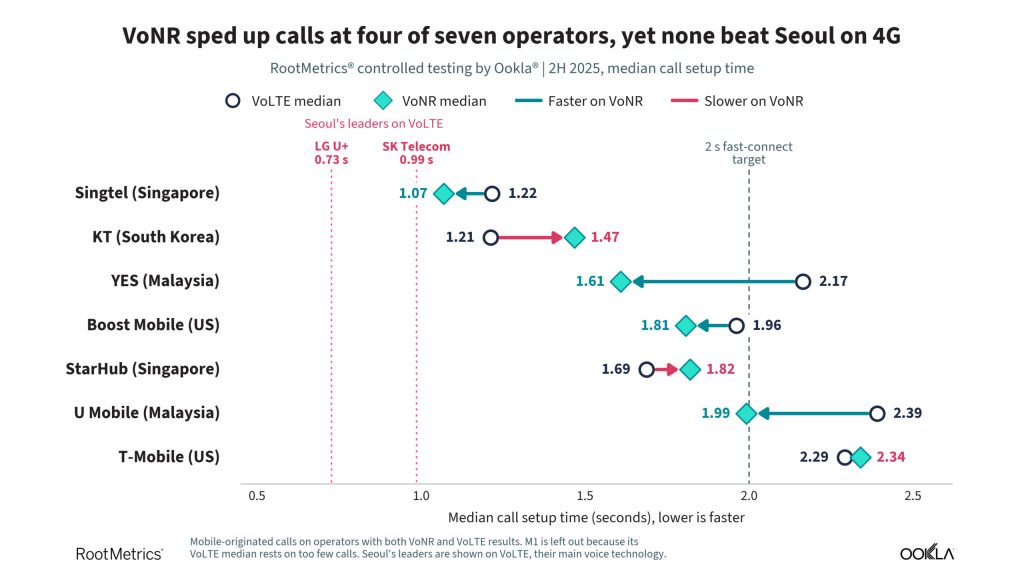
Ookla has provided some interesting findings in Malaysia which compares Yes 5G and U Mobile. These are the only two telcos in Malaysia to implement 5G SA and VoNR commercially to mass consumers but we can see that both telcos recorded different voice experiences.
Yes activated 5G Standalone nationwide in Q3 2025, with its 5G core connected to Digital Nasional Berhad’s radio network. Its 5G SA implementation also supports VoNR, allowing supported devices to make voice calls directly over 5G instead of dropping back to 4G.
Based on Ookla’s measurements, Yes’ implementation demonstrates that VoNR can deliver the faster call setup experience expected from native 5G voice. Yes recorded 2.17 seconds on VoLTE and 1.61 seconds on VoNR, which is 26% faster.
Meanwhile, U Mobile recorded 2.39 seconds on VoLTE and 1.99 seconds on VoNR, which is 17% faster.
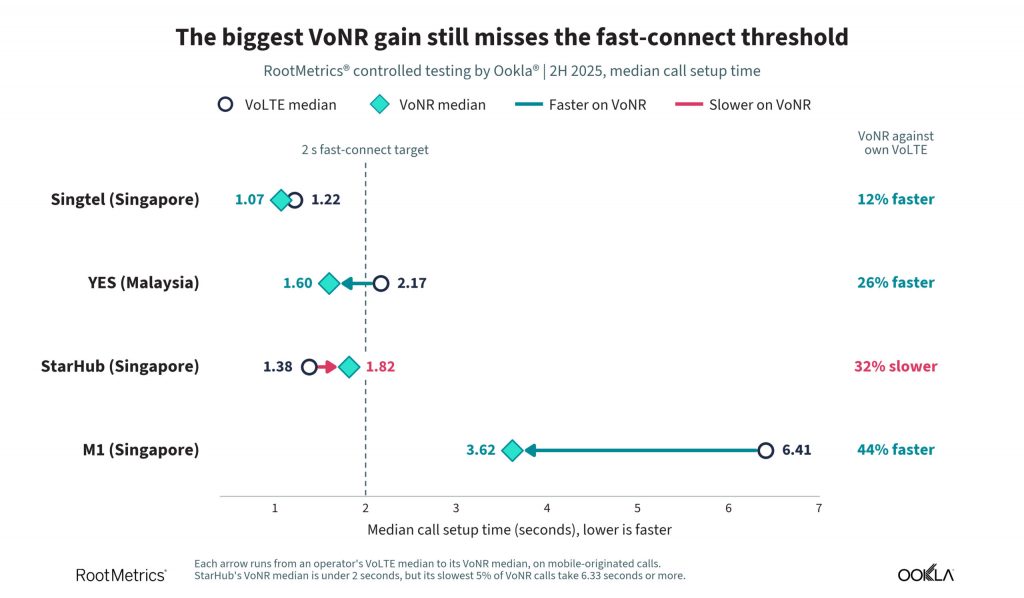
Singapore’s Singtel has the best VoNR performance recorded by Ookla. A voice call is connected in just 1.22 seconds on VoLTE and an impressive 1.07 seconds on VoNR.
Singapore’s M1 has also shown the biggest gains with a jump from 6.41 seconds on VoLTE to 3.62 seconds on VoNR. However, at over 3 seconds, M1’s VoNR still lags behind majority of VoNR implementations in the region.
The finding shows that the configuration of the radio network, 5G Core, IMS voice platform and fallback behaviour all play a role in what the user actually experiences.
Ookla notes that many operators that deployed 5G SA may intentionally choose to prioritise SA for data first while keeping VoLTE as the voice anchor on low-band. It added that some may use EPS fallback as a risk-managed bridge where its 5G SA footprint isn’t complete or mature.
Newer VoNR isn’t always faster than VoLTE
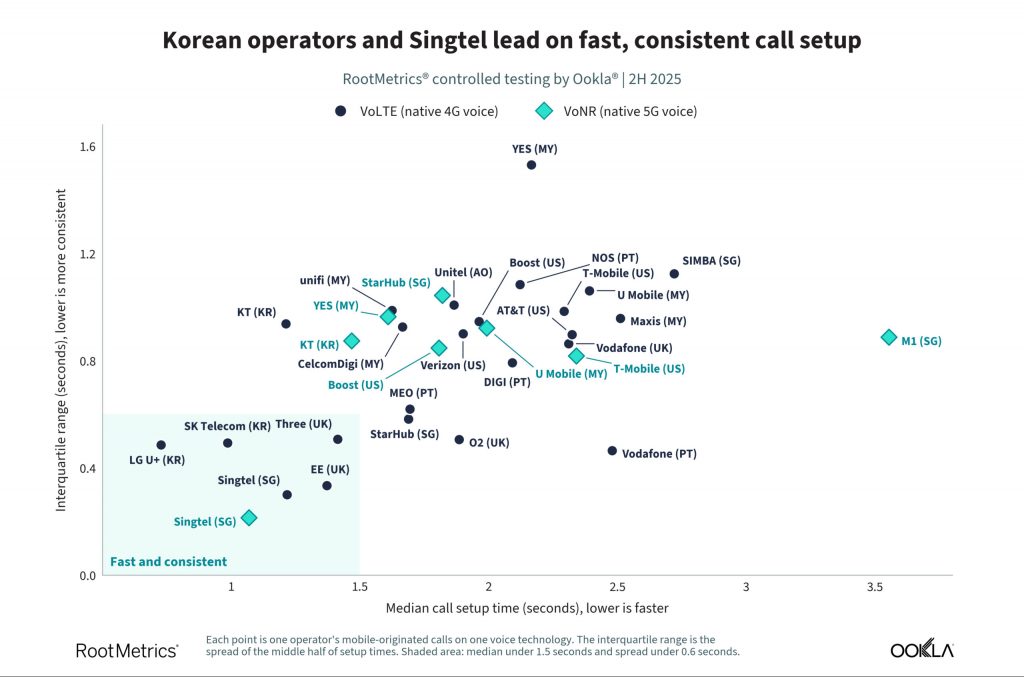
In some examples, VoNR may show worse performance compared to VoLTE. In South Korea and Singapore, some telcos’ VoNR implementations can actually take longer to establish a call than existing VoLTE networks.
South Korea’s KT recorded a longer delay from 1.21 seconds on VoLTE to 1.47 seconds on VoNR. Meanwhile, Singapore’s StarHub recording delays from 1.69 seconds on VoLTE to 1.82 seconds on VoNR.
US’ T-Mobile showed the worst result with 2.29 seconds on VoLTE to a much delayed 2.34 seconds on VoNR.
If a telco activates VoNR but the call takes longer to connect than VoLTE, the newer technology isn’t necessarily delivering a better experience. Essentially, it isn’t just the technology but how it is implemented.
A well-optimised 4G VoLTE network can establish calls quickly without needing to fall back to an older mobile network. As shown above, Singtel’s VoLTE implementation outperforms many global VoNR implementations including Malaysia and the telcos have a lot of room to improve.
South Korea’s LG U+ and SK Telekom remain leaders on VoLTE, clocking just 0.73 seconds and 0.99 seconds respectively to set up a call.
Good 4G and 5G coverage still matters
Coverage remains another important factor when deploying VoNR. A native 5G voice service works best when there is strong and continuous 5G coverage. If the 5G connection becomes unsuitable for maintaining the call, the network needs to handle the transition to another voice-capable layer properly.
This is where in-building coverage plays an important role to ensure consistent quality indoors. Several telcos have also enabled Voice over WiFi (VoWiFi) as a complementary technology to ensure optimal voice services indoors where cellular coverage is not available.
The same applies to VoLTE on 4G as well. If 4G coverage is poor or VoLTE isn’t available, the device may have to fall back to 3G or 2G network for voice.
In Malaysia, 3G was shutdown in 2022, leaving 2G as the final fallback technology. This means if you’re out of 5G or 4G coverage, your device will have to turn to legacy 2G which means slower call setup process and lower quality voice quality.