
• 中文版
  • BM
  • News
  • Deals
  • Reviews
    • First Impressions
    • Hands-on
    • Comparisons
  • Tech
    • Mobile
    • Computers
    • Cameras
    • Wearables
    • Audio
    • Drones
  • Telco
    • Celcom
    • Digi
    • Maxis
    • Time
    • Tune Talk
    • U Mobile
    • Unifi
    • Yes
  • Cars
  • Contribute
  • Jobs
Menu
  • 中文版
  • BM
  • News
  • Deals
  • Reviews
    • First Impressions
    • Hands-on
    • Comparisons
  • Tech
    • Mobile
    • Computers
    • Cameras
    • Wearables
    • Audio
    • Drones
  • Telco
    • Celcom
    • Digi
    • Maxis
    • Time
    • Tune Talk
    • U Mobile
    • Unifi
    • Yes
  • Cars
  • Contribute
  • Jobs
Search
  • Tech
    • News
    • Mobile
    • Computers
    • Cameras
    • Wearables
    • Audio
    • Drones
  • Telco
    • Celcom
    • Digi
    • Maxis
    • Time
    • U Mobile
    • Unifi
    • Yes
  • Reviews
    • First Impressions
    • Hands-on
    • Comparisons
  • Buyer’s Guide
  • Opinions
  • Digital Life
  • Video
  • Deals
  • How-To
  • Cars
  • Bahasa Melayu
  • EV
  • Contribute
  • Advertise
Menu
  • Tech
    • News
    • Mobile
    • Computers
    • Cameras
    • Wearables
    • Audio
    • Drones
  • Telco
    • Celcom
    • Digi
    • Maxis
    • Time
    • U Mobile
    • Unifi
    • Yes
  • Reviews
    • First Impressions
    • Hands-on
    • Comparisons
  • Buyer’s Guide
  • Opinions
  • Digital Life
  • Video
  • Deals
  • How-To
  • Cars
  • Bahasa Melayu
  • EV
  • Contribute
  • Advertise
Search
Close
Home News

What you didn’t know about the white clouds left by planes

  • BY Savita Saravanan
  • 4 March 2020
  • 10:37 am
  • Comment
Share on FacebookShare on Twitter

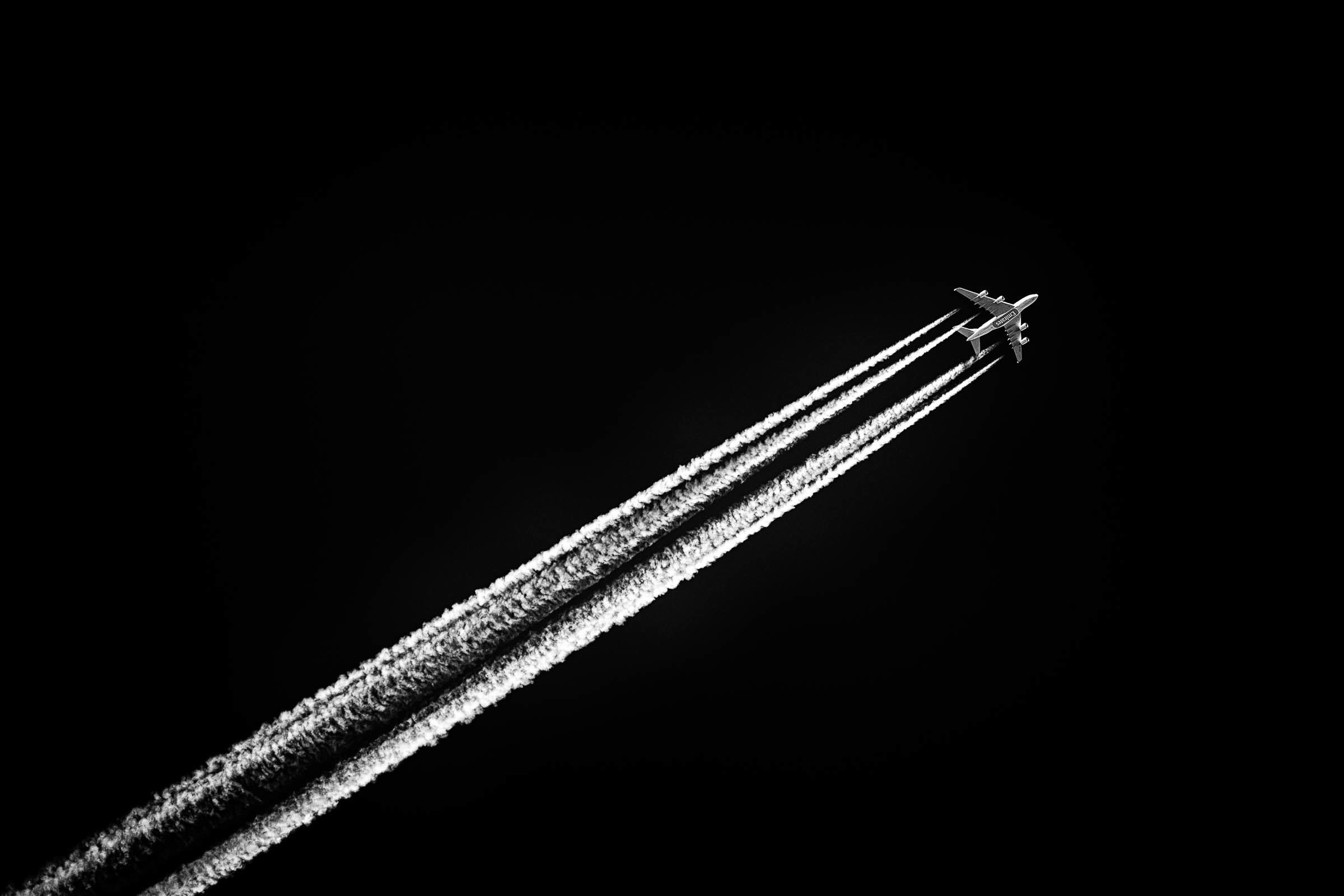
Jet exhausts commonly found on commercial planes often leave behind a trail of wispy, white clouds when they soar through the sky. Also known as contrails, these white clouds are the result of hot water-vapour filled engine exhaust interacting with cold air. However, what you may not know is that these vapour trails have the ability to trap heat near the earth’s surface, and it’s exacerbating climate change.

As much as it seems harmless, its ramifications can prove to be quite dire. Contrails can sometimes stretch up to 10 miles, or be spread by the wind, and can linger for hours. Due to this, sometimes old and new contrails can produce pits of airborne ice clouds that are called “contrail cirrus”—cirrus, after the hair-like cirrus clouds you find in the sky. This happens as plane after plane fly the same route over a period of time, and these clouds essentially trap heat that would otherwise head for space.
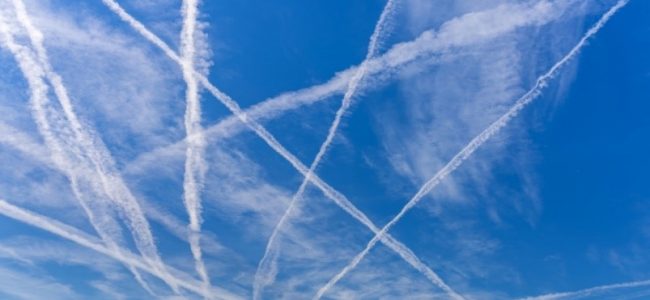
According to Wired, a study found that by the year 2050 as air traffic increases, the air-trapping effect of the contrail clouds could be three times greater than it was in 2006. NASA claims that clouds are a pivotal variable in the planet’s climate and temperature regulation.

A paper published in the journal of Environmental Science & Technology states that the most detrimental effects of contrails take place at night. This is because, on top of trapping heat like the daytime contrails can, those that linger on during the night can’t also deflect any sunlight, which is claimed to balance out its impact.

But, there is some good news. Based on the research conducted, the paper found that just 2.2% of all flights create a staggering 80% of contrail related warming. And for the most part, these are flights that take place in the late afternoon and early evening because their contrails carry on into the night.

Contrails form when the air is heavily saturated with air molecules, which can attach to soot particles from engine exhaust and condense, grow into ice crystals, and join into clouds. However, this is often confined to a narrow band of altitude and planes can navigate to drier areas by moving up or down.

So, according to the researchers, by diverting just 2% of flights either 2,000 feet up or down, we could reduce the total climate impact of contrails by 59%. However, as flight paths are generally designed to minimise fuel consumption, whether companies would be willing to make this diversion for no monetary gain remains to be seen.

[SOURCE , IMAGE SOURCE]

Tags: contrailsglobal warmingplanes
Savita Saravanan

Savita Saravanan

POPULAR

What you didn’t know about the white clouds left by planes

March 4, 2020

Malaysia to review EV policy amid concerns over strict rules affecting BYD CKD operations in Tanjung Malim

April 17, 2026

Zeekr 8X: Premium 900V PHEV SUV, up to triple-motor setup and 0–100km/h in 2.96s

April 20, 2026
Apple Tap To Pay on iPhone Malaysia

Apple’s Tap to Pay on iPhone is now in Malaysia

April 22, 2026

Malaysia’s EV policy and the BYD debate: Are affordable EVs at risk? | Let’s Talk About #140

April 19, 2026
vivo V70 FE 200MP camera phone in Malaysia - Best value alternative for phones under RM2,000

High-Resolution Meets High-Endurance: A Closer Look at the vivo V70 FE

April 10, 2026

Copyright © 2025 · SoyaCincau.com
Mind Blow Sdn Bhd (1076827-P)

  • ADVERTISE
  • DISCLAIMER

Copyright © 2026 · SoyaCincau.com – Mind Blow Sdn Bhd (1076827-P)

  • ADVERTISE
  • DISCLAIMER