

• 中文版
  • BM
  • News
  • Deals
  • Reviews
    • First Impressions
    • Hands-on
    • Comparisons
  • Tech
    • Mobile
    • Computers
    • Cameras
    • Wearables
    • Audio
    • Drones
  • Telco
    • Celcom
    • Digi
    • Maxis
    • Time
    • Tune Talk
    • U Mobile
    • Unifi
    • Yes
  • Cars
  • Contribute
  • Jobs
Menu
  • 中文版
  • BM
  • News
  • Deals
  • Reviews
    • First Impressions
    • Hands-on
    • Comparisons
  • Tech
    • Mobile
    • Computers
    • Cameras
    • Wearables
    • Audio
    • Drones
  • Telco
    • Celcom
    • Digi
    • Maxis
    • Time
    • Tune Talk
    • U Mobile
    • Unifi
    • Yes
  • Cars
  • Contribute
  • Jobs
Search
  • Tech
    • News
    • Mobile
    • Computers
    • Cameras
    • Wearables
    • Audio
    • Drones
  • Telco
    • Celcom
    • Digi
    • Maxis
    • Time
    • U Mobile
    • Unifi
    • Yes
  • Reviews
    • First Impressions
    • Hands-on
    • Comparisons
  • Buyer’s Guide
  • Opinions
  • Digital Life
  • Video
  • Deals
  • How-To
  • Cars
  • Bahasa Melayu
  • EV
  • Contribute
  • Advertise
Menu
  • Tech
    • News
    • Mobile
    • Computers
    • Cameras
    • Wearables
    • Audio
    • Drones
  • Telco
    • Celcom
    • Digi
    • Maxis
    • Time
    • U Mobile
    • Unifi
    • Yes
  • Reviews
    • First Impressions
    • Hands-on
    • Comparisons
  • Buyer’s Guide
  • Opinions
  • Digital Life
  • Video
  • Deals
  • How-To
  • Cars
  • Bahasa Melayu
  • EV
  • Contribute
  • Advertise
Search
Close
Home News

Android fragmentation issue visualised

  • BY ccsoya
  • 8 December 2010
  • 1:17 am
  • Comment
Share on FacebookShare on Twitter

One of the marks of a good operating system is consistency. What makes the iPhone so stupidly easy to use is the fact that where ever you are in the OS, no matter how many layers deep you’re in the settings menu, all the buttons — be it soft or hardware buttons — do the same thing and they are all at the same place.

With Android however, things get a little bit tricky, the open source nature of the OS means that manufacturers can essentially customise the platform — with layers of UI skins atop the original Android OS — to virtually any shape and form making maintaining consistency across the board a bit of a challenge to say the least.

This inconsistency, or fragmentation as it is more widely known, becomes very evident when you compare the buttons on some of the more popular Android device side by side. You’ll see the numerous permutations of the number of buttons a device has, its general location and its function.

Head on over to after the jump to see what we mean.
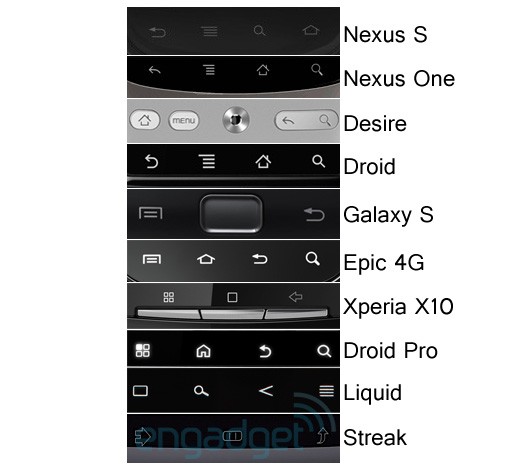
As you can see, even with devices co-developed with Google — the Nexus One and the Nexus S — you can see the difference between the locations of the buttons, albeit slightly.

But is fragmentation an issue? Already we’re seeing Android climbing to the top of the mobile OS charts at a blistering pace and from our own experience, jumping from one manufacturer’s Android device to another is never an issue for us.

What about you? Do you think that the fragmentation of the Android OS is a big issue? Comment us.


[picture credit]

Tags: AndroidAndroid fragmentationAndroid fragmentation issuegoogle
ccsoya

ccsoya

POPULAR

The Single-Stock Trap: Why True Tech Investing Means Moving Beyond a Few Famous Tickers

June 25, 2026

Android fragmentation issue visualised

December 8, 2010

Proton Saga Cross AMA02 spotted undergoing testing at Federal Highway

July 14, 2026

Jaecoo J5 EV: First look at the potential Proton e.MAS and BYD challenger

July 11, 2026

NanoMalaysia: Malaysia’s upcoming homegrown EV battery can help deliver over 600km of range

July 13, 2026

Astro X3 lets you stream instantly with no box or installation, from RM39.99/month

July 7, 2026

Copyright © 2025 · SoyaCincau.com
Mind Blow Sdn Bhd (1076827-P)

  • ADVERTISE
  • DISCLAIMER

Copyright © 2026 · SoyaCincau.com – Mind Blow Sdn Bhd (1076827-P)

  • ADVERTISE
  • DISCLAIMER