
Fans of Virtual Reality (VR) have long complained about the “screen door” effect. The term refers to the vertical and horizontal lines, or gaps in between pixels, that are noticeable when you stare at a display that is very close to your eyes like in a VR headset. But this annoyance might be a thing of the past thanks to Samsung and Stanford University’s new OLED technology.
The advancements are based on research performed by Stanford University material scientist Mark Brongersma together with the Samsung Advanced Institute of Technology (SAIT) that would enable displays like TVs, smartphones and VR devices to output resolutions of up to 10,000 pixels per-inch (PPI).
To put that into perspective, that pixel density is well above what’s employed in commercial large-scale OLED TVs which normally have 100 to 200 PPI whereas the average smartphone offers around 400 to 500 PPI. The idea is that this solution will be useful for VR and AR applications as it would allow for virtually ‘flawless’ images where you can’t see the screen door effect or individual pixels, thereby enhancing the illusion of seeing another reality.
“We’ve taken advantage of the fact that, on the nanoscale, light can flow around objects like water. Our designs worked really well for solar cells and now we have a chance to impact next-generation displays,” said Brongersma.
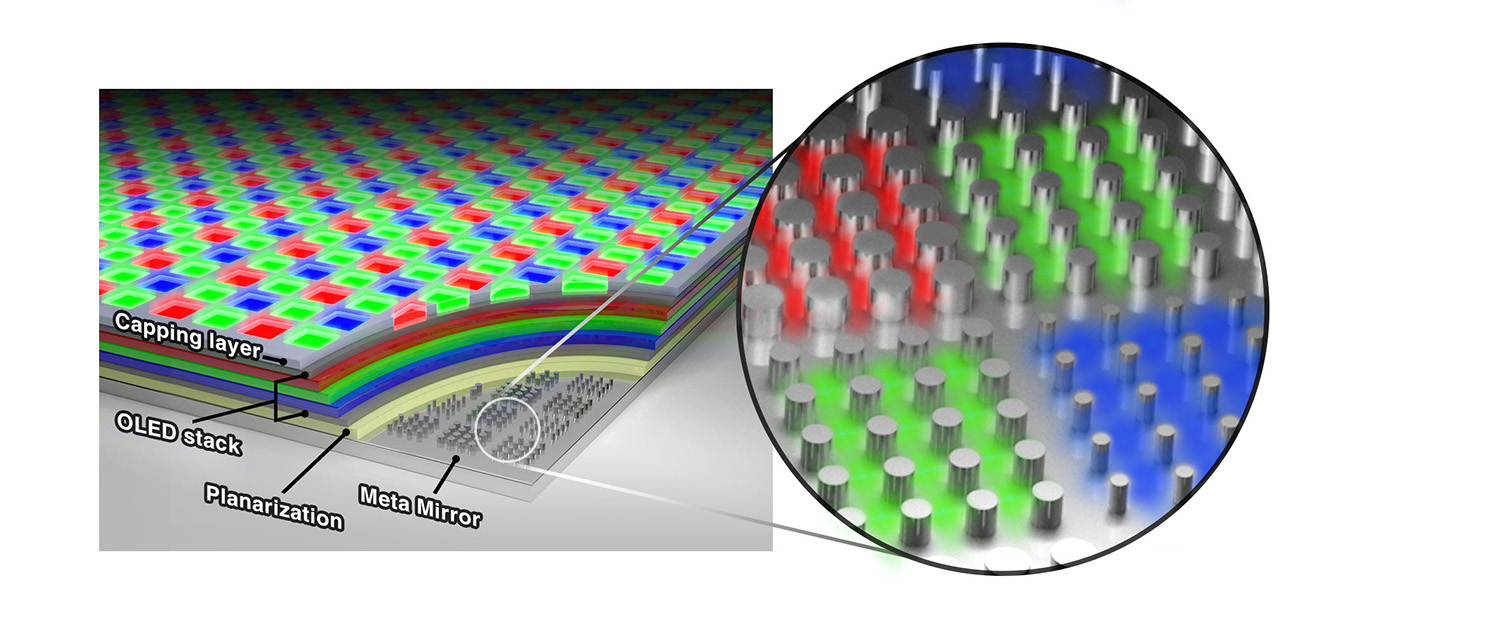
The new tech Samsung and Stanford OLED tech is said uses film to emit white light between two reflective layers, with one made of silver film and the other made of reflective metal. This “optical metasurface” then changes in its reflective properties and allows specific colours to resonate through the pixels.
IEEE explains that there are two kinds of OLED displays are used in mobile devices and TVs today. Most mobile devices use RGB (Red, Green, Blue) OLEDs that display dots of organic film through metal sheets with many tiny holes punched in them. But the thickness of these metal sheets limit how small the fabricated dots can be while limiting how large these displays can get.
For TVs that use white OLEDs with colour filters placed over then, these filters can absorb more than 70% of light from the display. This results in displays that are power-hungry and suffer “burn-in” of images that linger too long.
We certainly can’t wait to see this breakthrough in OLED technology come to mainstream devices but the Engadget notes that is that it might take years for the new technology to be widely available as it would require significantly more computing power. On the bright side, it is highly likely that OLED tech would have advanced significantly by then and no longer would be an obstacle.
Samsung and Stanford are not alone in their quest for higher PPI displays. Other research groups have also developed displays that are claimed to offer 10,000 to 30,000 PPI. These use micro-LED technology like Jade Bird Display in China and VueReal in Canada.