The Malaysian Communications and Multimedia Commission (MCMC) has announced that Internet messaging and social media platforms with at least 8 million users in Malaysia will be deemed registered as Applications Service Provider Class (ASP(C)) licensees starting next year.
This is done through a dispensation of formalities under Section 46A of Communications and Multimedia Act 1998 (CMA 1998) (Deeming Provisions), before the Online Safety Act (ONSA) 2024 is set to take effect on 1st January 2026.
The move applies to service providers that fall under Malaysia’s Internet messaging and social media licensing framework, which has been in force since 1st January 2025, and is aimed at ensuring that large-scale platforms operate within Malaysia’s legal and regulatory framework in a consistent and effective manner.
Auto “licensing” to hold platforms accountable
According to MCMC, this approach is intended to strengthen accountability and compliance with Malaysian law, while also placing clearer responsibility on platforms for user safety, particularly in safeguarding children from online harm.
MCMC says the implementation of the Deeming Provision will apply to the following service providers effective 1st January 2026:
- Telegram
- TikTok
- YouTube
The regulator added existing service providers that have already registered as an ASP(C) licensee will remain registered and the implementation will only take effect only after their existing registration period has expired.
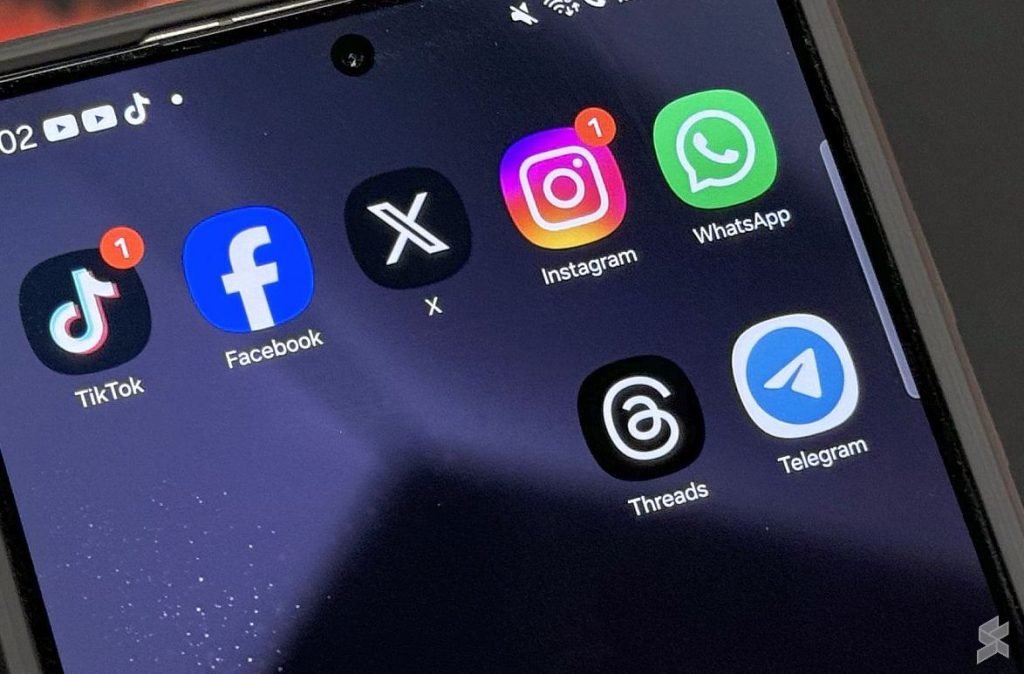
Following the social media regulation introduced by MCMC, only TikTok, WeChat and Telegram have obtained the required ASP(C) licence this year. Other applicable platforms such as Facebook, Instagram, WhatsApp, X and YouTube are still operating without a licence based on recent checks.
While the Malaysian government had previously assured that it won’t ban or block platforms operating without the licence, non-compliant service providers can be fined up to RM500,000, or face imprisonment up to 5 years, or both. The platforms are also liable for a further fine of RM1,000 for every day during which the offence is continued after conviction.
Deeming Provision introduced to address regulatory gaps
According to the FAQ published by MCMC, the Deeming Provision under Section 46A of the Communications and Multimedia Act 1998, introduced through amendments in 2025 and effective from 11 February 2025, allows service providers to be deemed registered as class licensees through a Ministerial Declaration, without going through a formal registration process.
Once deemed as a licensee, the service provider is treated in law as a class licensee and is subject to the same regulatory obligations under the CMA 1998, its subsidiary legislation and other applicable regulatory instruments.
The provision was introduced to address regulatory gaps, particularly for service providers operating remotely from outside Malaysia, and to ensure that activities falling within Malaysia’s regulatory framework are governed by Malaysian law.
A deemed registration remains valid until it is cancelled, and the applicable service providers must comply with all applicable legal and licensing requirements, including appointing a local representative in Malaysia if they are foreign-based. Failure to comply may result in regulatory or legal action, including fines and financial penalties.
Will this make Social Media platforms more accountable?

The question remains if the move will hold social media platforms truly accountable for online scams and harmful content.
As we have documented extensively, Meta has been defiant by not only operating without a licence, but also continuing to allow scam ads on its platform that target Malaysians. These approved scam ads misused identities of popular brands and Malaysian public figures to scam victims.
It was recently reported that Meta has made over RM70 billion from scam ads in 2024 and has ignored over 96% of scam reports to minimise the impact on its ad revenue.