The 12.9″ iPad Pro has arrived with the biggest screen upgrade since 2018, with the new mini-LED display supposed to offer a huge brightness upgrade—and a possible bridge to OLED iPad screens in the future. Users have already raved about the new technology and what it offers, but there are now reports popping up that complain about a “blooming” effect on the top-of-the-line 12.9″ iPad Pro’s display.
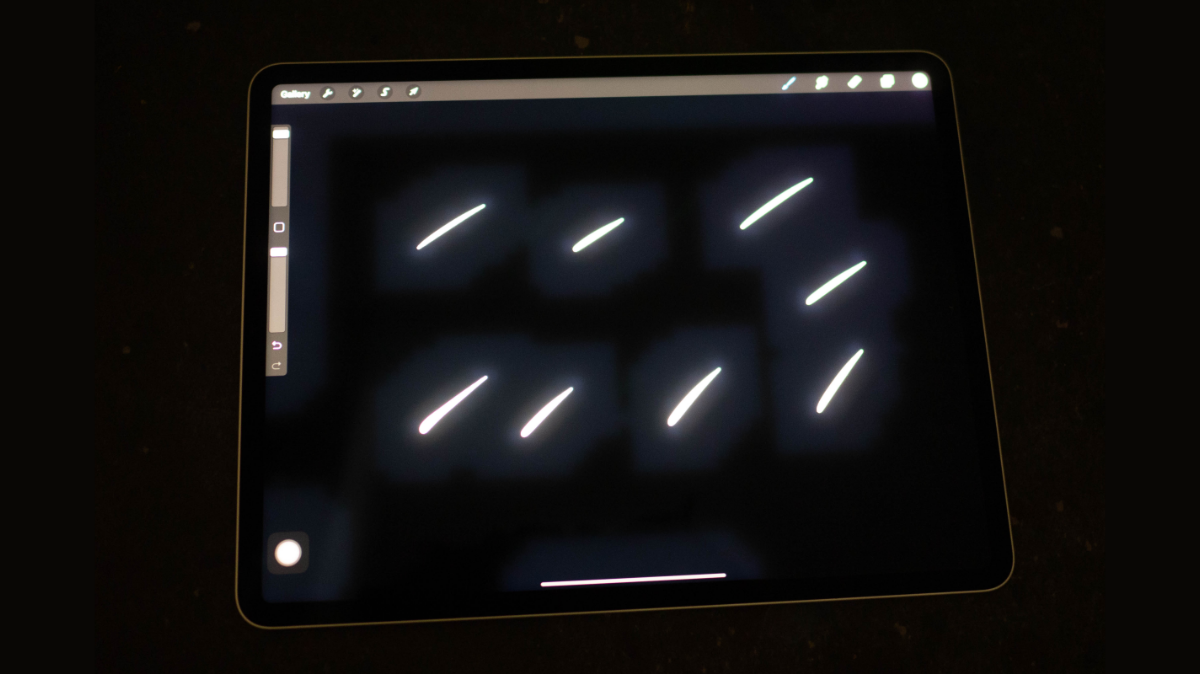
Basically, the issue happens when using the tablet in dark environments, with users complaining that a slight blooming effect can be seen around the edges of bright areas on-screen. Have a look at some images:
According to @JoshTeder, the effect isn’t really noticeable—you only really see it when certain things like UI controls pop up. In normal daily use, you probably won’t see it too often; however, an OLED display would probably do better at separating the dark and whites compared to mini-LED displays, to be fair.
What can happen when you have 2,500 dimming zones. This is noticeable when you use iPad Pro 2021 in total darkness.
— Parka (@ParkaBlogs) May 21, 2021
iPad Pro 2018 has less distracting blooming because the bloom covers a large area. And there's IPS glow.
More on this tomorrow https://t.co/yGqFwdeJwz pic.twitter.com/7q82vAvc5d
Similarly, @ParkaBlogs showed off the same blooming effect on his iPad Pro 2021. Interestingly, they contrasted the effect on the new iPad Pro (left) to the 2018 iPad Pro (right), revealing that the IPS-equipped iPad Pro 2018 also suffers from the same effect—but because it is spread out over a large area, it’s less noticeable.
As mentioned above, this is an issue that wouldn’t happen on OLED displays. OLED panels have pixels that can be individually turned on or off (hence the “true” blacks, and so on), while LED LCD displays are backlist with LEDs, which means that excess light should be expected to bleed into the surrounding pixels.
Mini-LED displays, like the one on the 2021 iPad Pro 12.9″, use smaller LED diodes, which should mean that darks can be more specific to areas on the display. This is how Apple explains it:
“Unlike the previous design that takes light emitting from one edge of the display and evenly distributes it across the entire back, the Liquid Retina XDR display uses over 10,000 custom-designed mini-LEDs spread uniformly across the entire back of the display, delivering higher LED density than any other display of its kind. These mini-LEDs are grouped into an array of over 2,500 individually controlled local dimming zones. This delivers incredibly deep blacks right next to bright image areas, achieving a 1,000,000:1 contrast ratio.”
While I don’t have a unit to play with myself, I doubt that this is a deal-breaker with the new iPad Pro. It’s still an improvement over the LCDs of the previous generation iPad Pro, and I wouldn’t really consider this to be a design flaw per se—it’s simply a matter of the technology. One day, we will probably (hopefully) see OLED displays on the iPad, which should (hopefully) see an end to the dimming/bleeding complaints.
What do you think?