

Back in 2018, Samsung took the stage at Unpacked to show off the Galaxy Home, a bulbous, tripod-legged smart speaker meant to plant Bixby squarely into living rooms. What followed instead was a protracted cycle of delays, missed launch windows, and eventual radio silence, leaving Samsung without a distinct footprint in the standalone home audio space.
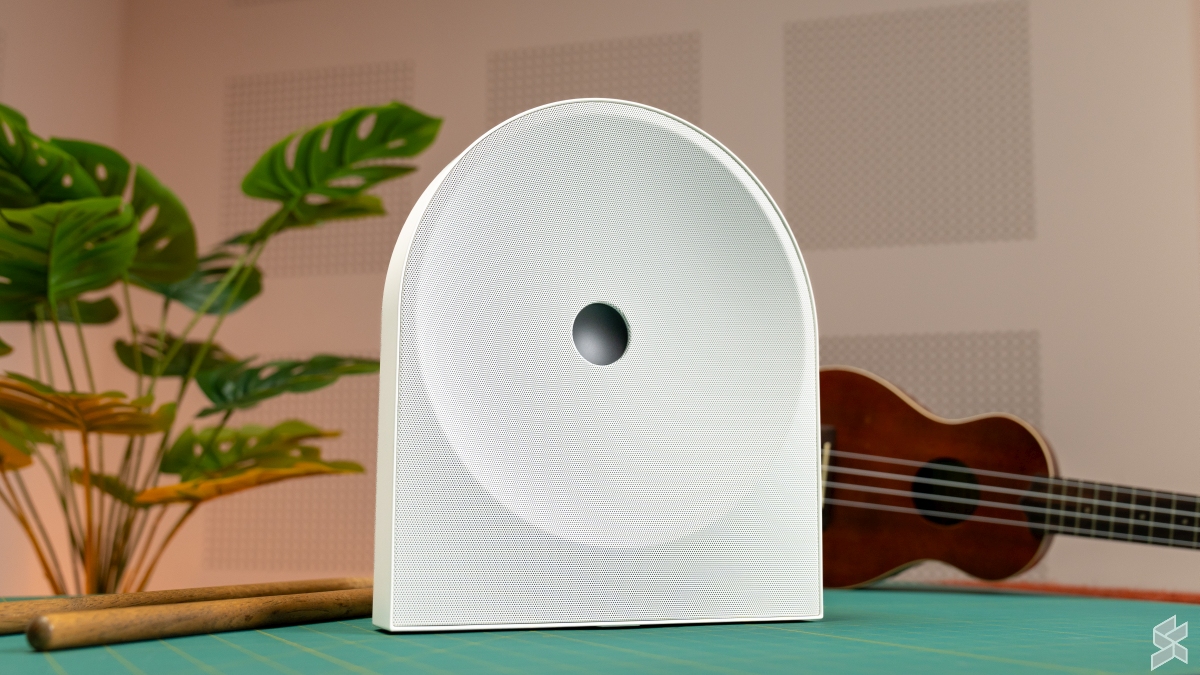
Fast forward to 2026, and the company is trying its hand at the category again with the Music Studio lineup, comprising the larger Music Studio 7 and the smaller Music Studio 5. We have the smaller sibling: the Music Studio 5, priced at RM999 (RRP: RM1,299).
On paper, the approach seems noticeably recalibrated. The push to centre everything around an in-house voice assistant has been ditched, replaced by mainstream ecosystem support and a more design-led aesthetic.
A promising spec sheet and a clean profile are one thing, but whether Samsung has actually carved out a compelling identity in home audio this time around will take real listening time to determine.
For now, here is what the speaker looks like out of the box and our initial thoughts after getting it set up.
What is the Samsung Music Studio 5?
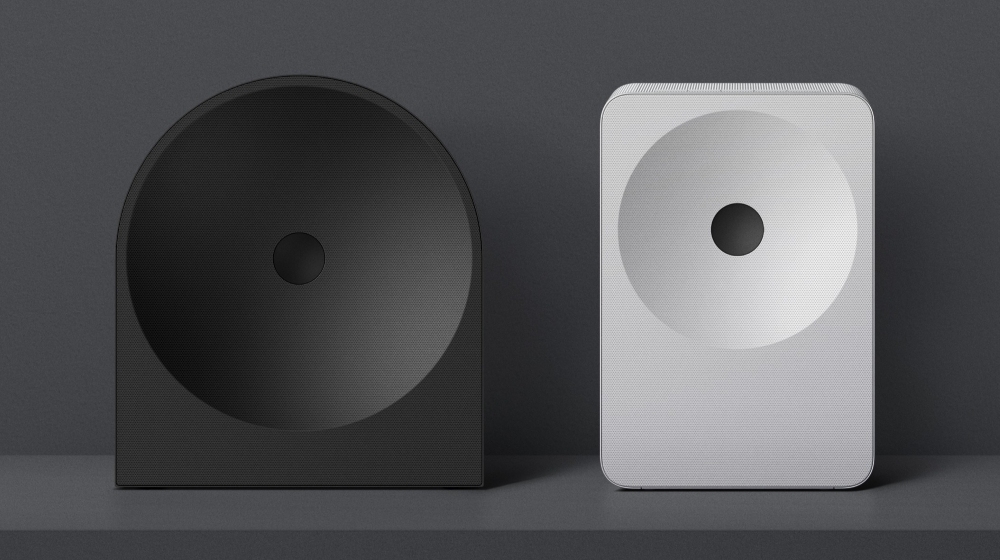
Samsung introduced the Music Studio line in two tiers: the flagship Music Studio 7, a substantially larger, more powerful unit built for open-plan living rooms with an expanded driver array, and the more compact Music Studio 5, which is on our desk.
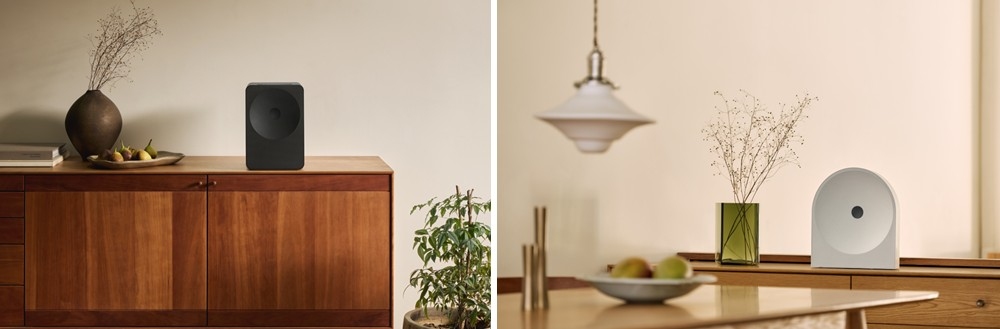
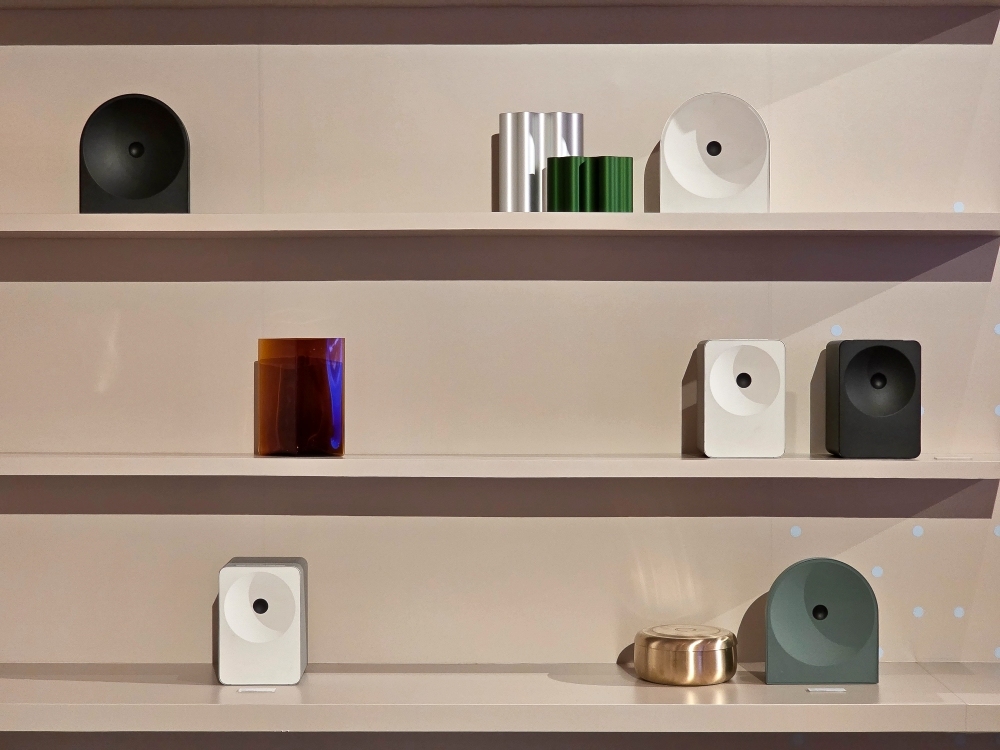
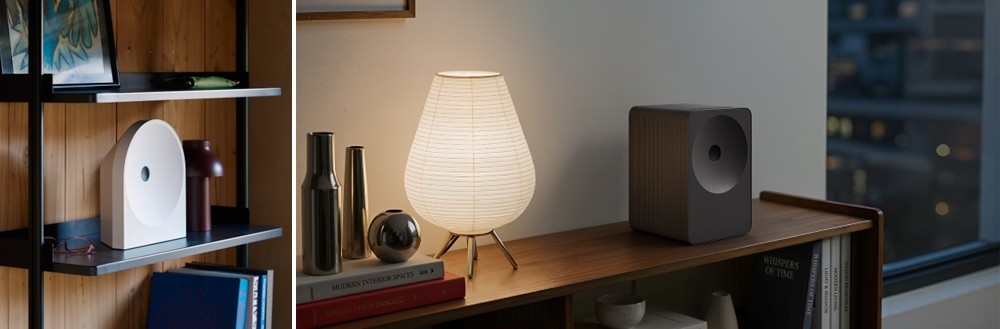
Both share a sculpted, lifestyle-oriented design language created in collaboration with French designer Erwan Bouroullec, but the Studio 5 is tailored specifically for desks, credenzas, and smaller listening spaces.
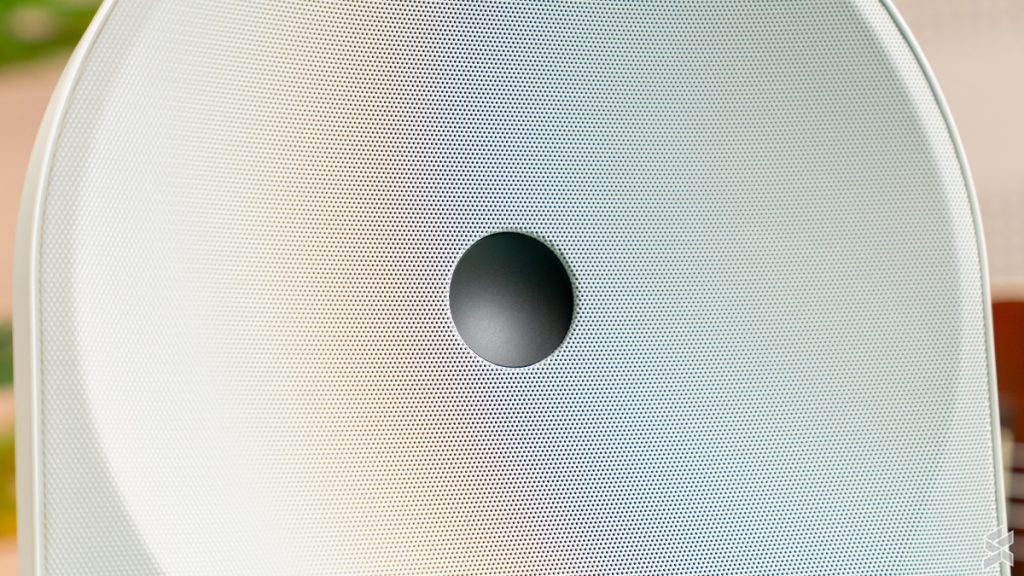
At 2.4 kg, it houses a 2.0-channel acoustic setup powered by three active drivers. Up front, a pair of tweeters flank a dedicated central woofer, wrapped in a tightly woven acoustic fabric grille and framed in matte plastic.
Driving that acoustic array is an internal amplifier rated at 70W of total output power. The onboard DSP is spec’d to decode Hi-Res Audio streams up to 24-bit/96kHz, alongside support for Dolby Atmos Music, Dolby Digital Plus, and multichannel Dolby 5.1 bitstreams.
Samsung also touts its proprietary AI Dynamic Bass Control, an algorithm designed to monitor woofer excursion in real time to keep low-frequency distortion in check as volume scales up.
Set-up is easy peasy
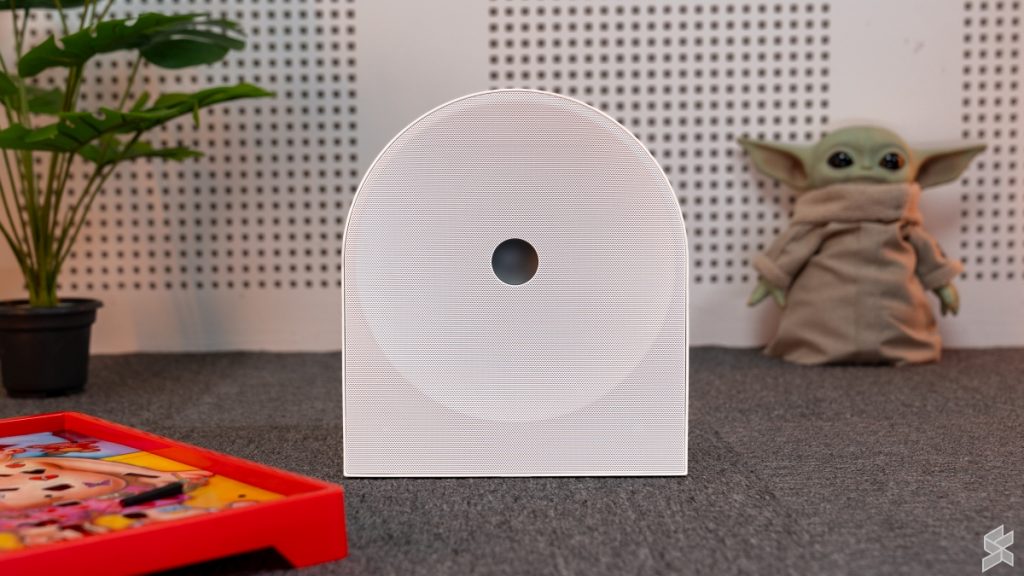
Inside the packaging, Samsung keeps things decidedly minimal. You get the Music Studio 5 unit itself, an external power adapter with its accompanying cord, and the standard quick-start documentation.
Beyond that, the bundle is bare-bones: there’s no dedicated remote control, and despite featuring an optical input on the back, Samsung doesn’t bundle an optical cable, meaning you will need to supply your own if you plan on wiring it directly to a TV or external source.
Pairing the device can be done via the SmartThings app or the Samsung Sound app. Since Samsung installs SmartThings by default on Galaxy devices, I used it to set up the Music Studio 5. After choosing the device category, the app almost immediately detects the speaker and starts the setup process.
Once done, you’ll see it listed in the app. Almost all of the Music Studio 5’s features are accessed through the SmartThings app or the Samsung Sound app.
Physical Controls
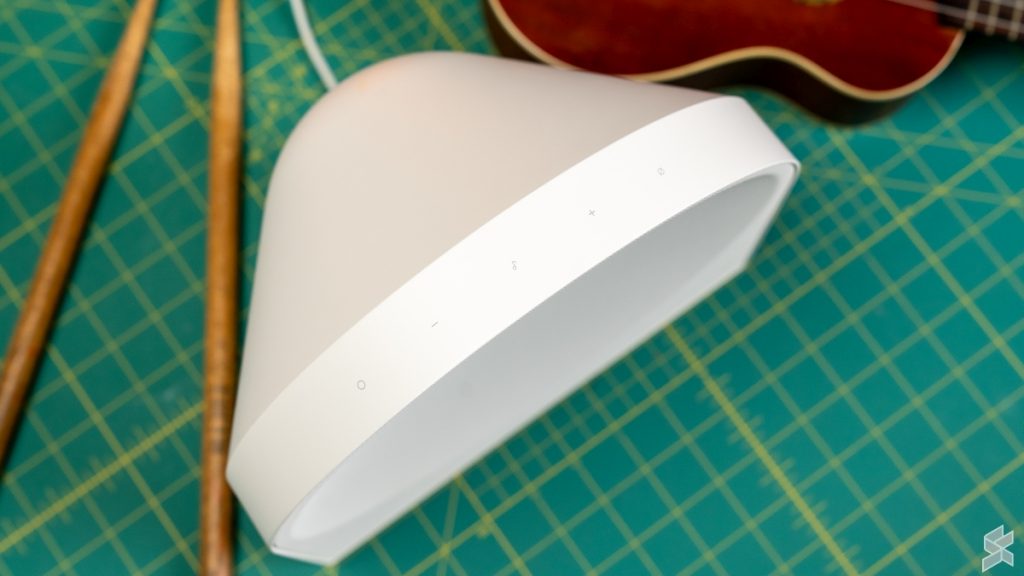
Up top, Samsung integrates a flush capacitive touch panel that covers most of the essentials. You get volume controls, an input selector to toggle between Wi-Fi, Bluetooth, and the optical source, and a microphone toggle that cuts power to the far-field mics (used for SpaceFit room calibration and Active Voice Amplifier ambient noise sensing).
Playback is handled by a single “Instant Music Play” touch button. A single tap plays or pauses, while a double tap skips forward to the next track or launches Spotify Tap; you will still need to reach for your phone if you want to skip backwards.
The controls sit completely flat against the top deck with no backlighting, raised tactile guides, or haptic feedback. Compounding that is the slim strip of LED status indicator behind the fabric at the top arch, which is so faint that it is virtually invisible in ambient daylight or typical indoor lighting. You practically have to be standing in a pitch-black room to notice it glowing.
Without clear visual confirmation or tactile reassurance, figuring out whether a press actually registered or what source mode the unit is in often leaves you second-guessing and defaulting straight back to the smartphone app or just listening for the change.
Connectivity and I/O
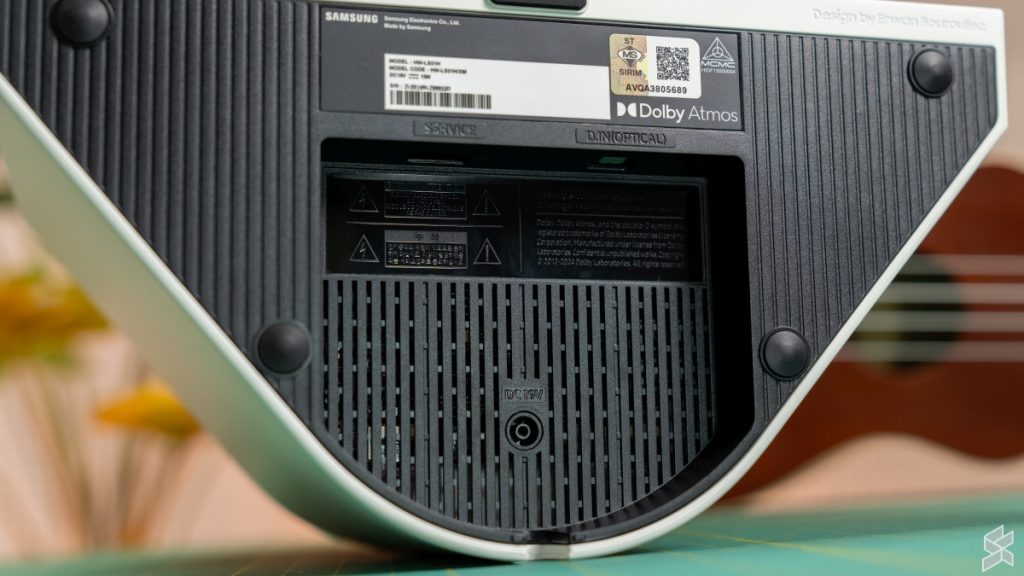
Spin the Music Studio 5 around, and the port selection reinforces its clear identity as a wireless home speaker.
Physical I/O is kept strictly to the essentials: just a DC power port and a single optical audio input. You won’t find an HDMI eARC port or a traditional 3.5mm auxiliary jack here.
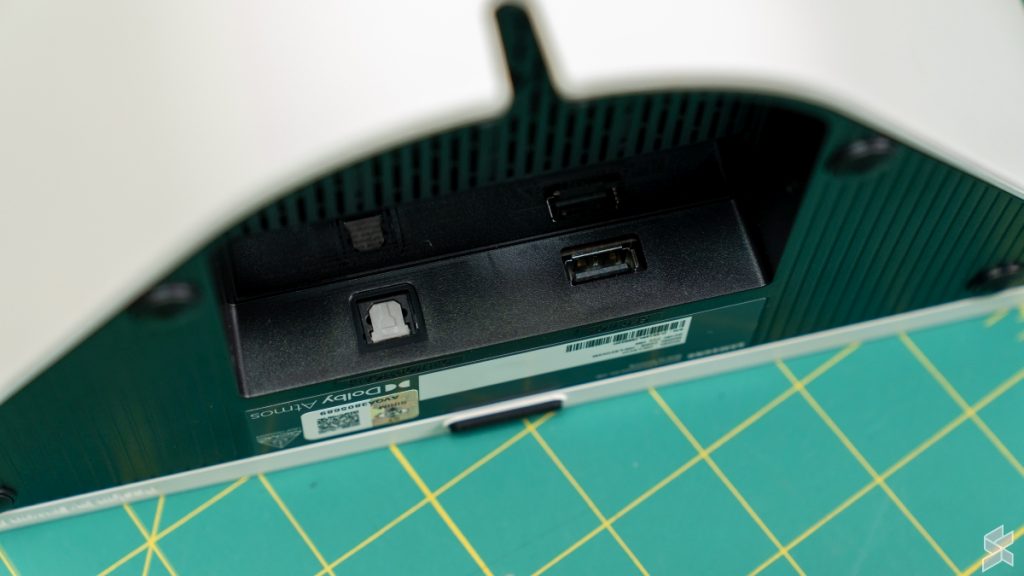
While some might note the absence of HDMI eARC for a direct television link, holding that against a dedicated wireless music speaker feels unwarranted. Samsung does provide routes to connect to a screen, either via that optical port or wirelessly through Q-Symphony if you happen to own a compatible Samsung TV.
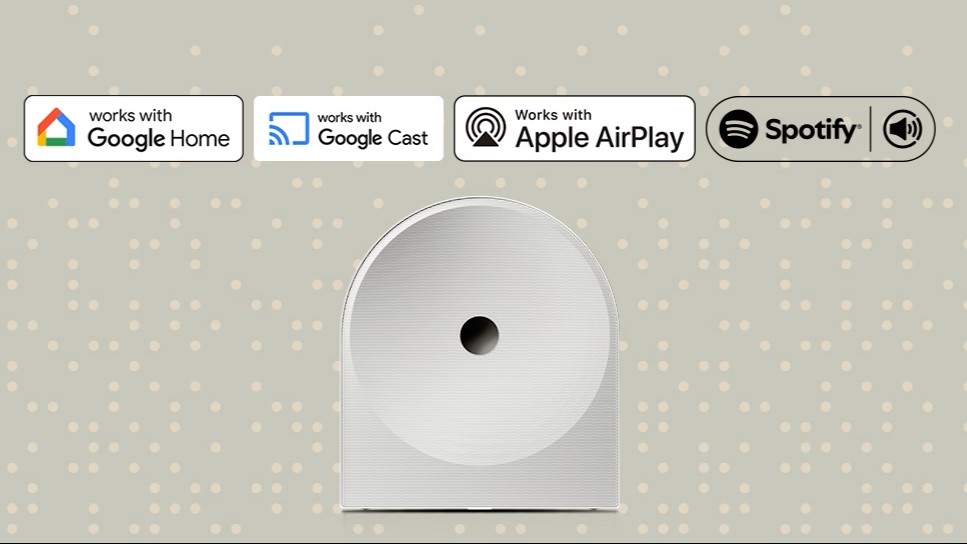
Where the speaker really shines is in its wireless streaming flexibility. It supports dual-band Wi-Fi and Bluetooth alongside a healthy suite of universal casting options. You get Google Cast, Apple AirPlay, and Spotify Connect straight out of the box.
Smart Capabilities
Given Samsung’s history with connected audio, it is worth clarifying what the Music Studio 5 actually is, and just as importantly, what it isn’t, on the smart home front.
First, this is not a smart assistant speaker. Despite having far-field microphones built into the top deck, they operate exclusively as acoustic sensors for Samsung’s SpaceFit room calibration and Active Voice Amplifier features.
There is no on-device Bixby or Google Assistant constantly listening for wake words. You cannot shout across the room to check the weather, set a kitchen timer, or tell the speaker to switch playlists.
Second, unlike many of Samsung’s soundbars, the Music Studio 5 does not pull double duty as a SmartThings IoT Hub. It lacks the built-in Thread, Zigbee, or Matter controller hardware needed to discover, onboard, and bridge smart home accessories like sensors, smart plugs, or lighting directly into your network.
Instead, the speaker functions strictly as a managed endpoint within the SmartThings ecosystem. While it cannot control your other devices, it can be seamlessly controlled by them.
Once connected to your home Wi-Fi, it shows up inside the SmartThings app as an audio target that plays nicely with home automations: you can have it automatically spin up a morning playlist when a motion sensor triggers or mute audio when a smart doorbell rings.
Home Theatre Integration
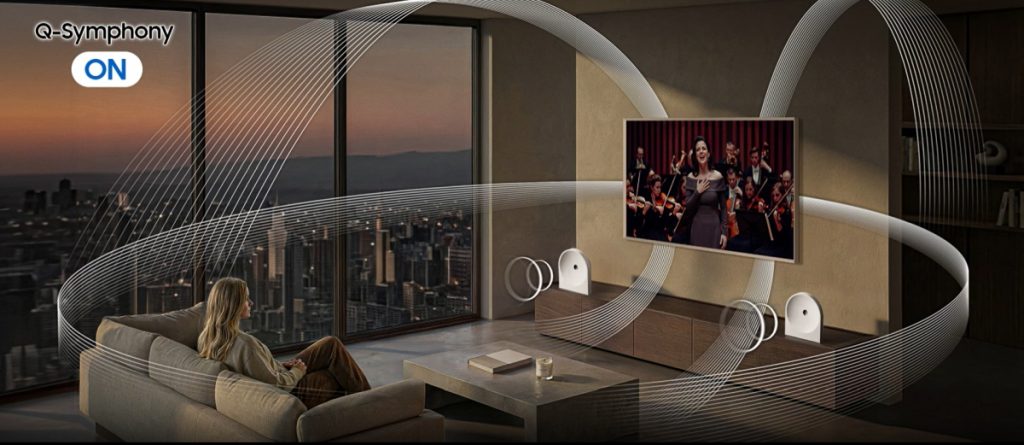
If you intend to bring the Music Studio 5 into a living room setup for the TV, how it behaves depends entirely on what it is plugged into.
For standard TVs and third-party media sources, connectivity comes down to the single optical port on the back. The speaker’s DSP accepts and decodes multi-channel Dolby formats, but because it is fundamentally a 2.0-channel stereo unit, it immediately downmixes that audio to fit its two physical drivers.
You get stereo separation and clear dialogue, but you won’t get discrete surround steering or a dedicated centre channel. Optical also lacks HDMI-CEC controls, meaning volume adjustments cannot be handled via your standard TV remote.
Connect it wirelessly to a compatible Samsung TV via Q-Symphony, however, and the TV’s processor changes how audio is distributed. On flagship Samsung sets equipped with physical top-firing drivers, Q-Symphony routes height effects up toward the ceiling while the Studio 5 drives the lower frequencies.
But even on more common mid-range Samsung TVs with basic down-firing speakers, Q-Symphony still intelligently divides the workload: the TV’s built-in drivers are filtered to anchor dialogue and vocal clarity directly at the screen, while the Music Studio 5 takes over the mid-range body and bass.
It won’t replace a massive multi-speaker home theatre system, but within the ecosystem, it functions as an intelligent audio expansion rather than just a standalone desktop box.
Initial Audio Impressions
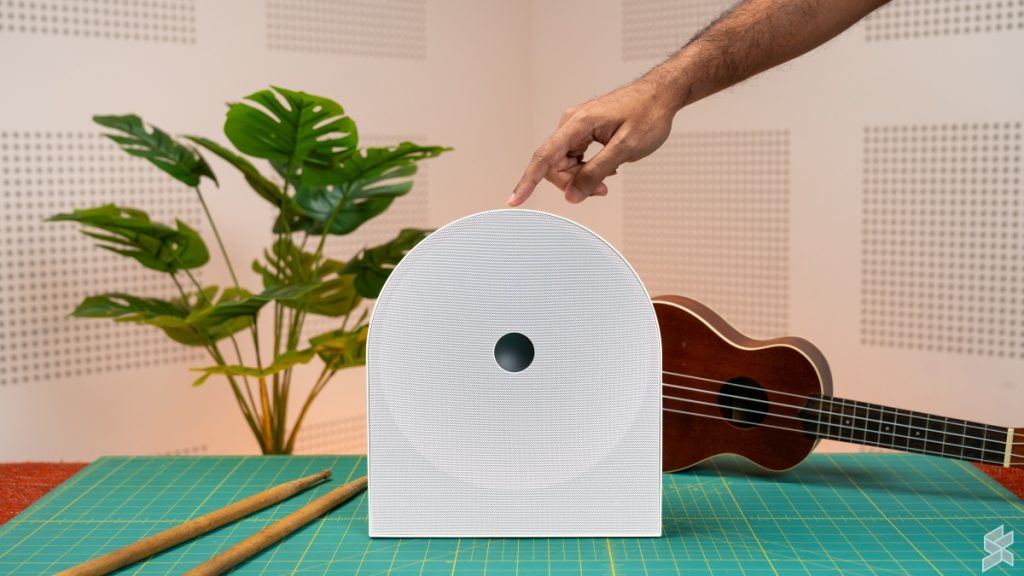
Dropping the needle on a few test tracks, the first thing that stands out about the Music Studio 5 is just how much raw output it has on tap. Backed by a 70W power rating, the speaker punches well above what its compact desktop footprint suggests. In a typical medium-sized room, dialling the volume up to around 45% is already plenty loud enough to comfortably fill the space, leaving a generous amount of headroom before you ever need to push it into strained territory.
Judged on its own terms, without pitting it head-to-head against established category veterans just yet, the initial sound character is genuinely impressive and makes casual listening immediately engaging. For a standalone tabletop unit handling everyday streaming, it makes a very strong first impression.
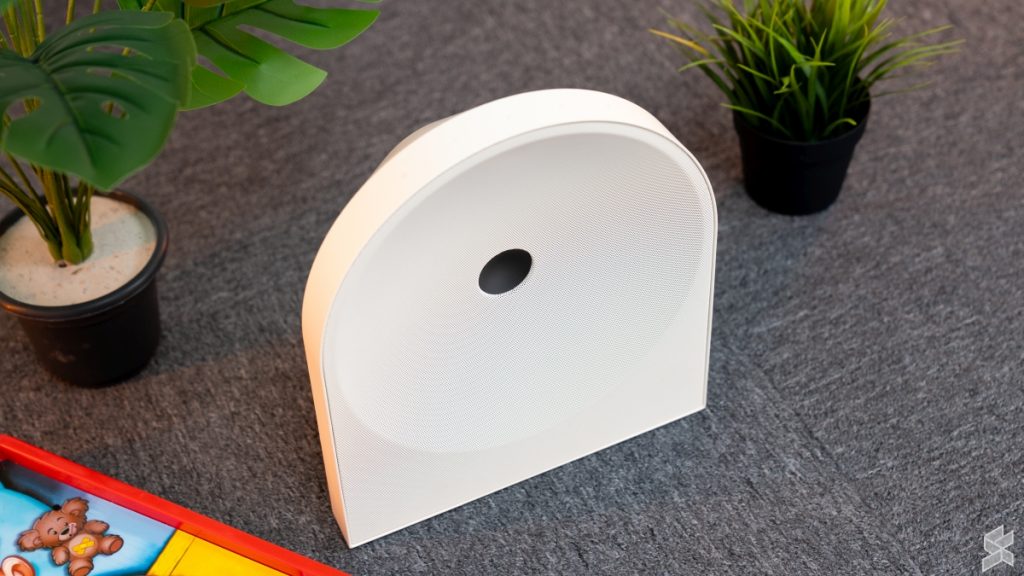
The trade-off, however, lies in its spatial presentation. Despite the Dolby Atmos badging and Samsung’s acoustic processing, the soundstage is noticeably narrow. Audio doesn’t quite detach itself from the hardware to create a wide, airy field; instead, playback feels unmistakably tethered to the physical confines of the cabinet.
You are always acutely aware of exactly where the box is sitting. Whether stereo-pairing a second unit solves that directivity remains to be seen, as we only have a single unit in for review. But out of the gate, it performs much more like a potent point-source speaker than an expansive room-filling soundstage.
Putting It Through Its Paces
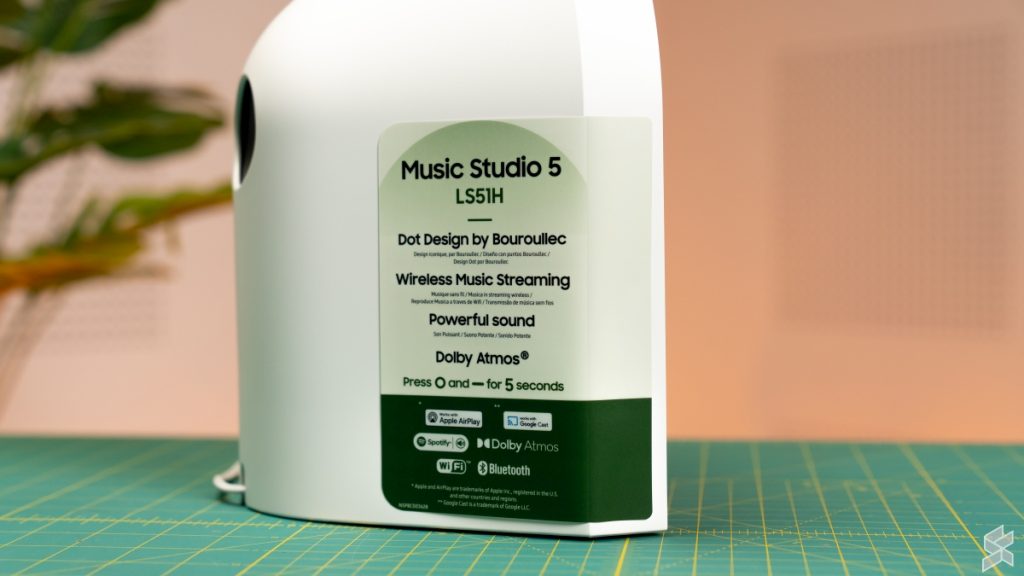
Over the coming weeks, we will be putting the Music Studio 5 through its paces and seeing if those flat touch controls and dim status LED become an annoyance day to day.
Crucially, we will also be pitting it head-to-head against our benchmark in compact home audio: the Apple HomePod mini. In our earlier review, we gave Apple’s pint-sized sphere glowing marks for its acoustic tuning, crowning it the undisputed best-sounding smart speaker under RM1,000.
While the Music Studio 5 commands a higher asking price and deliberately skips voice assistant features to focus purely on sound, its larger cabinet and 70W output give it a clear architectural advantage on paper.
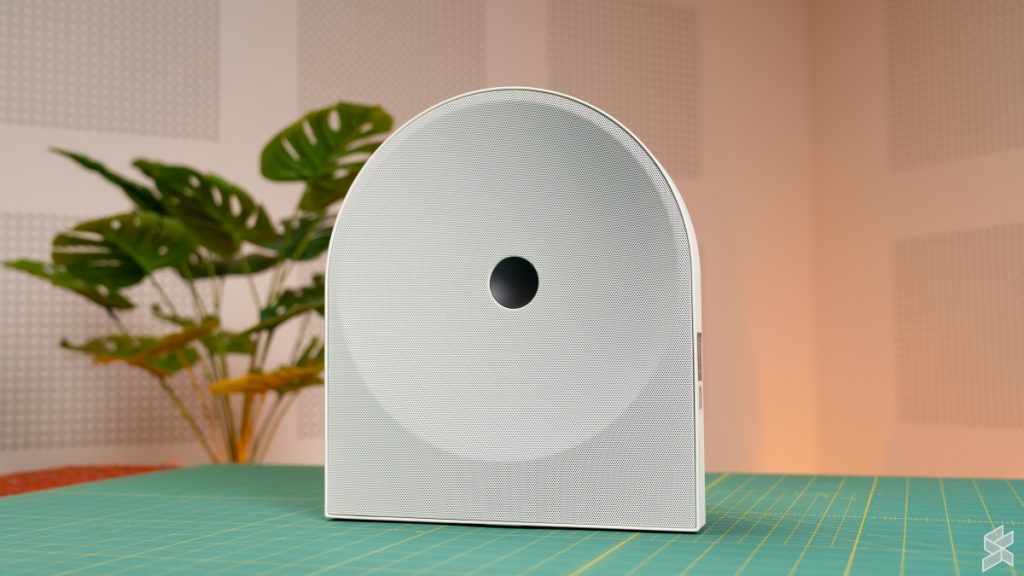
Whether Samsung’s dedicated 2.0-channel hardware and designer pedigree can genuinely out-resolve Apple’s computational audio prowess and ultimately dethrone the HomePod mini on sheer sound quality is the question we aim to answer.
Shopee | Lazada