

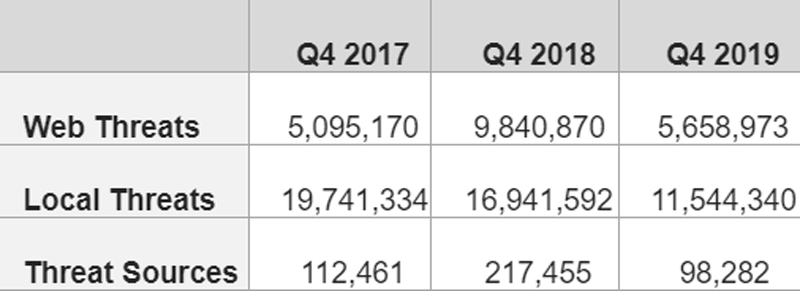
In its Kaspersky Security Bulletin Q4 2019 for Malaysia, Kaspersky revealed that cyberthreats are heading towards a downward trend as Malaysians are now privier towards cyberthreats online.
However, that isn’t entirely good news as the cybersecurity company detected 11,544,340 local threats on the participating Kaspersky Security Network (KSN) computers in Malaysia. Overall, 31.9% of users in Malaysia were almost infected by local threats during the period of October to December.
Local Threats are malware that are spread via removable USB drives, CDs and DVDS, and other offline methods. Worms and file viruses make up most of these threats.
“We continue to encourage Malaysians to start practising an improved cybersecurity culture as another decade begins. Cybersecurity is not a boring subject to discuss with your employees, friends, and families because simple habits can greatly boost your enterprise and personal defences against potential cyber threats,” says Yeo Siang Tiong, General Manager for Southeast Asia at Kaspersky.
“We are highly motivated with the announcement by CyberSecurity Malaysia about its Malware Detection and Alert System, with the aim to reduce the impact of threats for organisations, through local public-private collaboration. It is important that everyone works together to bolster our defences against common threats. No one knows when the next threat will appear. Keep your system intelligent and up to date with the latest cybersecurity trends so you are ready and prepared for sophisticated cyberattacks,” he added.
Kaspersky’s security experts advise that to be secured against the rapidly evolving threats online, it is important to always remember some very basic but important steps:
- Carefully check the link before visiting a site, especially for misspelling or other irregularities, even if it’s for a site you visit regularly.
- Enter your username and password only over a secure connection. Avoid logging in to online banks and similar services via public Wi-Fi networks.
- Be aware that URLs that begin with the “https” may not always be secure.
- Don’t trust emails from unknown senders until you can verify the authenticity of their origins.
- Always run a system with a quality, up-to-date anti-malware program.
For businesses and companies, these are some of Kaspersky’s recommendations:
- Educate employees about the risks – like the basic rule to not open emails from people they do not know as well as attachments or links.
- Advocate good password habits in the workforce including using unique passwords and keeping it safe from anyone’s access.
- Set up tiered levels of access, giving permission only to those who need it on each level.
- Incorporate global threat feeds into their systems which can provide in-depth visibility into cyberthreats targeting organisations.
- Conduct regular cybersecurity training which will deliver knowledge on latest threats and more importantly to improve employee habits and form new behavioural patterns for a safer work environment.